Friday, August 1, 2025

Targum Onkelos and Quran: Islam/submission of Abraham

Quran records an interesting divine commandment to prophet Abraham: 

Qur’an 2:131:
(إِذۡ قَالَ لَهُۥ رَبُّهُۥٓ أَسۡلِمۡۖ قَالَ أَسۡلَمۡتُ لِرَبِّ ٱلۡعَٰلَمِينَ)
Meaning: [When his Lord said to him: "Submit (Aslim)", he said, "I have submitted (Aslamtu) to the Lord of the Worlds."]  

Bible (Genesis 17:1)

"When Abram was ninety-nine years old, the LORD appeared to him and said, 'I am Almighty God; walk before me and be blameless.'"

  • The Hebrew command is "walk before me and be tamim" (וֶהְיֵה תָמִים).

  • Tamim (תמים) means "blameless," "complete," "perfect," "integral."

Aramaic Targum Onkelos

[Targum Onqelos is the official eastern translation of the Torah in Aramaic. ]
  • The Targum says: "שר קדמי והוי שלים"

    • "Sholaim/Shlim" (שלם / שְׁלִים): Meaning "whole," "complete," "at peace," and sometimes "in submission."


       Link
    • Link 2 

Brown-Driver-Briggs Lexicon 

  • שָׁלֵם / shalem means "to be complete, sound, whole," and in certain contexts, "to submit (oneself), especially to God."

  • The lexicon indeed notes the connection to the Arabic root سَلِمَ (salima) and أسلم (aslama) – submit, surrender (to God); hence, "Muslim" (مُسْلِمٌ): one who submits (to God).


    • So, there is an etymological link between Hebrew/Aramaic sh-l-m (peace, completeness) and Arabic s-l-m (submission, peace).


      That word could, especially in such a religious context, connote submission to God's will i.e Islam.

      "Walk before me and be submissive/surrendering/Muslim "

Main reference

Monday, April 29, 2024

Who wrote the Book of Judges? The Mystery of its Authorship and Date

 The Book of Judges does not provide any explicit information about its author, and the internal evidence suggests that the author lived after the period of the judges. 

Traditionally, some Jewish scholars have attributed the book to the prophet Samuel.

However, there are some challenges to this theory. The book seems to reference events that happened after Samuel's lifetime. So, most scholars believe the book was compiled and edited long after Samuel's time.

 
"Authorship and Date of Composition
 
THE BOOK OF JUDGES is anonymous. It is apparent that the book is a collection of various blocks of material concerning the different judges. Some of the stories may have existed very early in oral or written form, but none of these blocks are attributed to any particular source in the text. Modern scholars have expended great amounts of time and energy in an attempt to identify these sources, but with limited success.10
 
The reference in 18:30 to “the time of the captivity of the land” seems to refer to the Exile (either 722 or 586 B.C.) and suggests that the final edition of the book came from the Exile or afterwards.11 Thus the precise author and date are uncertain. But this should hardly deter the reader from understanding the book’s message."
 
[NIV Application Commentary Series. Judges, Ruth]


Wednesday, May 3, 2023

European Union Grants 2 Million Euros for Linguistic Investigation of Earliest Qur'an Manuscripts


Marijn Van Putten was paid from a grant of 2 Million Euros by the European Research Council, part of the European Union, to linguistically investigate the earliest Qur’an manuscripts. 
 
Marijn van Putten, Ph.D. (2013), Leiden University, is a historical linguist specializing in the linguistic history of Arabic, Berber and Semitic. In addition to this, his research focuses on the textual history of the Quran and the early history of the Quranic reading traditions.
 
 https://youtu.be/BwZ7S2C4Mtw


Friday, April 28, 2023

Jesus: The Abd/Slave/Servant/Abda/Ebed of God

Jesus is the Abd/slave/servant of God:


As we know, it's mutually exclusive to be "The Supreme Creator" [The Master] and to be His "Slave/servant" at the same time..

 
The Hebrew word "עֶבֶד" is related to the Arabic word "عبد" and to the Aramaic word  ܥܒܕܐ (ʿaḇdā). These words mean "servant" or "slave". 
 
 The Greek word pais derives from the Hebrew עֶבֶד ebed, which bears the primary meaning of servant, or slave. Hence, the primary translation of pais theou is “servant of God,” with “child” or “son of God” being an extravagant embellishment. According to the Theological Dictionary of the New Testament, “The Hebrew original of pais in the phrase pais theou, i.e., ebed, carries a stress on personal relationship and has first the sense of ‘slave.’
 
 
Abda , Abd, Pais, Ebed, Eved

 
This is all the more interesting because it dovetails perfectly with the prophecy of Isaiah 42:1, upheld in Matthew 12:18: “Behold, My servant [i.e., from the Greek pais] whom I have chosen, My beloved in whom my soul is well pleased …” Whether a person reads the King James , New KJ Version, NRSV, or NIV, the word is “servant” in all cases.
 
 
Bonus:
 
Here's how to write "slave of God" in Aramaic (the language of Prophet Jesus) with transliteration: 
 ܥܒܕܐ ܕܐܠܗ
(abda d'Alah)  
Note that the Aramaic script is written from right to left (as Arabic & Hebrew), and the transliteration represents the Aramaic characters using the English alphabet. 
For the Aramaic word of God, see the Aramaic Lexicon here.


Friday, June 10, 2022

Age of marriage in Hinduism

Today in India, the minimum age of marriage by law is at 18 years for women and at 21 for men. However, according to the official data, more than 12 millions [of which 84% are Hindus] are married below 10 years of age.  

More than 125 million males were married before the legal age (42% of male population) and more than 102 million females (30% of female population) were married before the legal age in 2011. (source)

Historically, there was no minimum age for marriage in India throughout ages. Books considered sacred by Hindus point out that it was common for girls about 6 or 8 years old to be married.  

The book Manu-smriti “Laws of Manu” that prescribes to Hindus their dharma (obligations) which is, according to Encyclopaedia Britannica, the most authoritative of the books of the Hindu code (Dharma-shastra) mentions in chapter IX (that concerned with issues related to marriages) a usual custom of marriage of girls 8 years old:

94. A man, aged thirty years, shall marry a maiden of twelve who pleases him, or a man of twenty-four a girl eight years of age; if (the performance of) his duties would (otherwise) be impeded, (he must marry) sooner. (source)

The laws of Manu also don't forbid that the girl is married before she attains the age of puberty:

88. To a distinguished, handsome suitor (of) equal (caste) should (a father) give his daughter in accordance with the prescribed rule, though she have not attained (the proper age).

The Gautama's Dharmasūtra, which is believed to be the oldest of the four Hindu Dharmasastras, doesn't consider puberty a prerequisite for marriage:

21. A girl should be given in marriage before (she attains the age of) puberty.

22. He who neglects it, commits sin. (source)

Indian gods have many stories of early marriages; the Skanda Purana, the largest of the eighteen Mukyapurana [major puranas], tell us about the marriage of Rāma to a 6 years old girl:

8-9. The bow of Īśvara that was kept in the abode of Janaka, was broken. In his fifteenth year, O king, Rāma married the six-year old beautiful daughter of the king of Mithilā, Sītā who was not born of a womb. On getting Sītā, Rāghava became contented and happy. (source)

 Another passage tells us about a 8 year old girl:

As time passed on she became a girl of eight years. The king recollected the words of the unembodied being and became worried. ‘To whom shall I give this daughter? Who will be the four-armed one?’......“Go ahead, O Kṛṣṇa, O mighty one. Let the jewel of a girl be seized quickly. I shall follow you closely behind causing much havoc unto all these demons.”.On getting the consent of Saṅkarṣaṇa, Keśava, the slayer of Keśin, seized the girl, immediately put her on the chariot and went off.(source)

Lately, Indian Prime Minister Modi government has proposed to raise the legal age of marriage of women to 21 from 18 years. According to PM Modi, increasing the legal age of marriage will empower girls and will help in building their careers.

Saturday, June 13, 2020

Do Christians believe that David is a biblical Prophet or he was "just a king" ?

Prophet David is well known by the followers of Islam, Christianity, and Judaism.

In Islam, David is recognized as a Prophet, a messenger, and a king. Muslims do not accept the sins of adultery and murder attributed to David in the Bible because Islam teaches us that the Prophets do not commit such grave crimes. David’s most significant role was his piety. His righteousness stands out, and his submission to God shapes his rise to power.

Abdullah Ibn Amr Ibn Al-As narrated: Allah's Apostle (pbuh) said to me: "The most beloved fasting to Allah was the fasting of the Prophet David, who used to fast alternate days. And the most beloved prayer to Allah was the prayer of David, who used to sleep the first half of the night, and pray for one third of it and again sleep for a sixth of it.'" (Bukhari).

The question is: Does the bible mention that David was a Prophet ?


The answer is Yes !


Acts 2:29-30 (NIV)
29 “Fellow Israelites, I can tell you confidently that the patriarch David died and was buried, and his tomb is here to this day. 30 But he was a prophet and knew that God had promised him on oath that he would place one of his descendants on his throne.

David also delivered God’s message and used his melodious voice to delight people and remind them of God. When he recited the Psalms the people, animals, birds and everything in nature listened and glorified God !

Friday, May 1, 2020

Is YHWH referred to in the Quran ?


By Ebrahim Saifuddin

There are Christians who tend to make a point that the Bible mentions in Exodus 3:14 that the name of God is “Yahweh” or “Jehovah” (depends on where one puts the vowels) but this name does not appear in the Qur’an. Hence they claim that the Qur’an cannot be the Word of God and Prophet Muhammad ﷺ cannot be a Messenger of God, because there is no reference to the personal name of God which appears in the Old Testament 6823 times.

YHWH (Yahweh) in the Bible

Let’s first read the concerned verse in the Bible in context:
Moses said to God, “Suppose I go to the Israelites and say to them, ‘The God of your fathers has sent me to you,’ and they ask me, ‘What is his name?’ Then what shall I tell them?”
God said to Moses, “I am who I am. This is what you are to say to the Israelites: ‘I AM has sent me to you.’”
God also said to Moses, “Say to the Israelites, ‘The LORD, the God of your fathers—the God of Abraham, the God of Isaac and the God of Jacob—has sent me to you.’ This is my name forever, the name by which I am to be remembered from generation to generation. – [Exodus 3:13-15]
The Hebrew word that is translated as “I AM” in English, is YHWH (known as the Tetragrammaton) which commonly the Christians read as Yahweh or Jehovah by inserting vowels. The Hebrew form of YHWH is as below:
יהוה
The objection which Christians raise is that as we see in Exodus 3:15, God says that this is his name forever thus they say if Prophet Muhammad ﷺ was a Messenger of Allah then he should have made some reference to this personal name of God, Yahweh/Jehovah, to prove that he is really a Messenger of God.

Pronunciation of the word YHWH

“Yahweh” and “Jehovah” are two pronunciations formed by humans much later. Although the Jewish Encyclopedia labels the word “Jehovah” to be a philological impossibility, the Christian world tends to use this pronunciation till this day. Coming back to the pronunciation of this word YHWH, the Catholic Encyclopedia brings it to our attention:
“According to a Rabbinic tradition the real pronunciation of Jehovah ceased to be used at the time of Simeon the Just, who was, according to Maimonides, a contemporary of Alexander the Great. At any rate, it appears that the name was no longer pronounced after the destruction of the Temple.”
Moreover we are also informed by the same encyclopedia that “the modern Jews are as uncertain of the real pronunciation of the Sacred name as their Christian contemporaries” [emphasis added]. Hence one thing has been made apparent that neither the Jews nor the Christians know the true pronunciation of this word. This word was considered to be ineffable by the Jews and thus with time people lost the knowledge of its true pronunciation.

Meaning of YHWH (Yahweh)

As it was made apparent that we do not know how to pronounce the word “YHWH”, we must now look and understand what this word means so as to get an understanding of the word itself. The Jewish Encyclopedia informs us that the meaning of the name “YHWH” is “‘He who is self-existing, self-sufficient’, or, more concretely, ‘He who lives’” [emphasis added]. Hence in simplest of terms “YHWH” means The Living and Self-Subsisting.

Did Biblical Jesus use the name YHWH?

Up till now two things have been made clear; the real pronunciation of the word is not available and that the meaning of this word is “self-existing and self sufficient”, in short “He who lives”. So now it must be established whether Jesus did use this name Yahweh in any place. The only verse which Christendom can quote to try to prove that Jesus used this word is in the Gospel of John which is as below:
“I tell you the truth,” Jesus answered, “before Abraham was born, I am!” – [John 8:58]
As we see that the verse consists of the phrase “I am”, the Christians say that Jesus has used the word YHWH. So let us take a look at the Greek version of the verse as we all know that the biblical manuscripts with the Christian world are in the language Greek although there is no concrete evidence that Jesus knew this language.
The words translated as “I am” are: ἐγώ εἰμί
Transliterated as: egō eimi
Pronounced as: eg-o’ i-mee’
So the words used here are “ego eimi” which simply means “I am” – a means of designating oneself. Not only “ego eimi” simply means “I am” as one would use “I am” in their everyday talk in the English language, “ego eimi” is no where near to the meaning of YHWH which is seen above to mean The Living, Self Subsisting. So not only does this not sound anything like the proposed pronunciation of the word YHWH, it does not even carry the meaning of the word.

Was “ego eimi” used Exclusively by Jesus?

The term “ego eimi” which simply means “I am” is used in numerous places in the Bible and there are instances when this term is used by people other than Jesus. Just to give a quick example, the blind man whom Jesus cured uses the same words as well in the Gospel of John:
Some said, This is he: others said, He is like him: but he said, I am he. – [John 9:9]
Do note the deception which the Christian world uses. In the Greek manuscripts there is no “he” in the text. The verse ends at “I am”. The same phrase “ego eimi” is used in the Greek texts. Due to the absence of “he” in the biblical manuscripts, “Young’s Literal Translation” provides the following translation for the same verse:
Others said — `This is he;’ and others — `He is like to him;’ he himself said, — ‘I am [he].’ – [Young’s Literal Translation of John 9:9]
Notice that the term “he” is placed in parenthesis because this word is not present in the biblical manuscripts. Any form of term that is not in the text being translated should be written in parenthesis to convey the meaning and not cause deception such that people would believe that it is part of the original text.

So by using the phrase “ego eimi” was the blind man suggesting that he was YHWH?

Obviously not and no Christian would dare to claim that he was. So then why did he use the term “ego eimi”? Simply because this word means nothing but the same as “I am” in the English language.
Similarly there are other examples in the Bible which prove that this phrase “ego eimi” was not used only by Jesus and it certainly does not hold the meaning of YHWH as seen earlier.
If, however Christendom wants to claim that “ego eimi” refers to “YHWH”, the personal name of God, they have to accept that when traveling from Hebrew to Greek, the word was not used as “YHWH” (Yahweh) but an alternate word(s) was used “ego eimi” which was a reference to the actual name YHWH.

Does Qur’an Make Any Reference to YHWH?

So far we have learnt 4 points which I will list so as to refresh all that we have learnt so far:
  •  Actual pronunciation of YHWH is lost.
  •  YHWH means “Self-Subsisting”, “The Living”.
  •  Jesus did not use the term “YHWH”.
  •  Christians cannot deny that traveling from Hebrew to Greek another term was used to refer to YHWH.
Thus we see that the Qur’an should have a reference to the term YHWH rather than having the term “YHWH” as the Qur’an was revealed in the Arabic and not the Hebrew. The golden question thus would be was any such reference made to the term “YHWH” in the Quran or by Prophet Muhammad ﷺ?
The answer is a definite “YES”.

We have learnt so far that the meaning of the term “YHWH” is The Living, Self Subsisting and although the term “Allah” is used in the Quran, this word simply means “The God”.
However, we know that Islamic teachings inform us of 99 names (attributes) of Allah and the Quran informs us that to Allah belongs the most beautiful names and we can call him by any of these beautiful names:

He is Allah, the Creator, the Evolver, the Bestower of Forms (or Colours). To Him belong the Most beautiful names: whatever is in the heavens and on earth, doth declare His Praises and Glory: and He is the Exalted in Might, the Wise. – [Quran 59:24]

Say: “Call upon Allah, or call upon Rahman: by whatever name ye call upon Him, (it is well): for to Him belong the Most beautiful names. Neither speak thy Prayer aloud, nor speak it in a low tone, but seek a middle course between.” – [Quran 17:110]

Thus we see that there are many different names of Allah, some of which I have listed below:
Al-‘Adl – The Just, The Equitable
Al-‘Afuw – The Pardoner
Al-‘Asim – The Protector
Ad-Dafi` – The Remover of Tribulations
Ar-Rahman Ar-Raheem – The Most Gracious, the Most Merciful

Just like these above-mentioned beautiful names of Allah we also learn of two other names which combined are read as Hayyul-Qayyum:

Hayyul-Qayyum – The Living, Self-Subsisting
YHWH – The Living, Self-Subsisting
Here it has been proven that there is clear reference to the name YHWH in the Qur’an which crumbles the Christian stand that Islam has no reference to the name YHWH and thus Prophet Muhammad ﷺ is not the Messenger of Allah.
Stressed Importance of Hayyul-Qayyum
One of the verses which has Allah referred to by the name Hayyul-Qayyum is in Ayat-ul-Qursi (The Verse of the Throne). Ayat-ul-Qursi has multitude benefits but apart from Ayat-ul-Qursi having its benefits, this verse with “Hayyul-Qayyum” mentioned in it was referred to by Prophet Muhammad ﷺ as the “greatest”:

Ubayy bin Ka’b said: Allah’s Messenger (May peace be upon him) said: O Abu’ al-Mundhir, do you know the verse from the Book of Allah which, according to you, is the greatest? I said: Allah and His Apostle (May peace be upon him) know best. He again said: Abu’l-Mundhir, do you know the verse from the Book of Allah which, according to you, is the greatest? I said: “Allahu La ilaha illa Huwal Hayyul Qayyum.” Thereupon he struck me on my breast and said: May knowledge be pleasant for you, O Abu’l-Mundhir! – [Sahih Muslim, Book 4, #1768]

In another narration, Prophet Muhammad ﷺ heard the man use “Hayyul-Qayyum” in his supplication and the Prophet ﷺ said that he has supplicated using Allah’s Greatest Name:
Narrated by Anas Ibn Malik: I was sitting with the Apostle of Allah ﷺ and a man was offering prayer. He then made supplication: O Allah, I ask Thee by virtue of the fact that praise is due to Thee, there is no deity but Thou, Who showest favour and beneficence, the Originator of the Heavens and the earth, O Lord of Majesty and Splendour, O Living One, O Eternal One.

The Prophet ﷺ then said: He has supplicated Allah using His Greatest Name, when supplicated by this name, He answers, and when asked by this name He gives. – [Abu Dawood, Book 2, #1490]
Yet another hadith to show the importance stressed by Prophet Muhammad ﷺ on the Hayyul-Qayyum:

Narrated by Asma’ daughter of Yazid: The Prophet (pbuh) said: Allah’s Greatest Name is in these two verses: “And your deity is one deity; there is no deity but He, the Compassionate the Merciful,” and the beginning of Surah Al ‘Imran, A.L.M. “Allahu La ilaha illa Huwal Hayyul Qayyum.”– [Abu Dawood, Book 2, #1491]

Conclusion

With the grace of Allah it can be seen that there is a clear reference to YHWH in the Quran. This reference is much stronger than what the Christians claim to be a reference to YHWH in the New Testament. The word “ego eimi” is in no way the Greek word for YHWH nor does it hold the meaning of YHWH. However as seen, there is a clear reference to the term YHWH in the Quran as well as the Hadith.

The Quran gives us many beautiful names of Allah, some of which have been mentioned above, and a Muslim can call upon Allah with any of his beautiful names unlike the followers of the Bible who do not even know how to pronounce the ‘personal name’ revealed to them. Indeed much of the truth in those books is lost just like the pronunciation of YHWH is lost and the Quran is sent to restore that which is lost – The Criterion.
Some More Beautiful Names of Allah
Al-Ghani – The Self-Sufficient, The Rich Beyond Need
Al-Awwal – The First
Al-‘Aakhir – The Last
Al-Barr – The Source of All Goodness
Al-Baaqi – The Everlasting One
Al-Haqq – The Truth
Al-Khaliq – The Creator
Al-Kafi – The Sufficient One
Ash-Shahid – The Witness

Monday, March 16, 2020

Re: Muhammad on Torah "I believed in thee and in Him Who revealed thee."

Question 
Did Prophet Muhammad believe in the corrupted Torah ?

Answer:

1- Is the hadith authentic ?
Narrated Abdullah Ibn Umar:
A group of Jews came and invited the Messenger of Allah () to Quff. So he visited them in their school.
They said: AbulQasim, one of our men has committed fornication with a woman; so pronounce judgment upon them. They placed a cushion for the Messenger of Allah () who sat on it and said: Bring the Torah. It was then brought. He then withdrew the cushion from beneath him and placed the Torah on it saying: 
"I believed in thee and in Him Who revealed thee."
He then said: Bring me one who is learned among you. Then a young man was brought. The transmitter then mentioned the rest of the tradition of stoning similar to the one transmitted by Malik from Nafi'(No. 4431). 

حَدَّثَنَا أَحْمَدُ بْنُ سَعِيدٍ الْهَمْدَانِيُّ، حَدَّثَنَا ابْنُ وَهْبٍ، حَدَّثَنِي هِشَامُ بْنُ سَعْدٍ، أَنَّ زَيْدَ بْنَ أَسْلَمَ، حَدَّثَهُ
 عَنِ ابْنِ عُمَرَ، قَالَ أَتَى نَفَرٌ مِنْ يَهُودَ فَدَعَوْا رَسُولَ اللَّهِ صلى الله عليه وسلم إِلَى الْقُفِّ فَأَتَاهُمْ فِي بَيْتِ الْمِدْرَاسِ 
فَقَالُوا يَا أَبَا الْقَاسِمِ إِنَّ رَجُلاً مِنَّا زَنَى بِامْرَأَةٍ فَاحْكُمْ بَيْنَهُمْ
 فَوَضَعُوا لِرَسُولِ اللَّهِ صلى الله عليه وسلم وِسَادَةً فَجَلَسَ عَلَيْهَا ثُمَّ قَالَ
 ‏"‏ ائْتُونِي بِالتَّوْرَاةِ ‏"‏ ‏.‏ فَأُتِيَ بِهَا فَنَزَعَ الْوِسَادَةَ مِنْ تَحْتِهِ فَوَضَعَ التَّوْرَاةَ عَلَيْهَا ثُمَّ قَالَ ‏"‏ آمَنْتُ بِكِ وَبِمَنْ أَنْزَلَكِ ‏"‏ ‏.‏ ثُمَّ قَالَ ‏"‏ ائْتُونِي بِأَعْلَمِكُمْ ‏"‏ ‏.‏ فَأُتِيَ بِفَتًى شَابٍّ ثُمَّ ذَكَرَ قِصَّةَ الرَّجْمِ نَحْوَ حَدِيثِ مَالِكٍ عَنْ نَافِعٍ ‏.‏
Grade
Hasan (Al-Albani)
  حسن   (الألباني)
حكم     :
Reference
In-book reference
 : Book 40, Hadith 99
English translation
 : Book 39, Hadith 4434


This report is considered weak because one of its reporters is Hisham ibn Sa'd whose narratives are disturbed and corrupted according to many hadith critics like Ibn Hanbal, Ibn Ma'een, Abu Hatem, al-Nisa'ee, Ibn Sa'd, Ibn 'Adii, al-Madini, al-Hakim, al-'Aqili, Ibn Habban and others.

This is the reason why Ibn Hazm notes:

"As for the report in which the Prophet (peace be upon him) took the Torah and said: "I believe in thee", it is a fabricated false report that did not reach us with proper chain of transmission" (Ibn Hazm, Al-Fisal fe al-Milal wa al-Ahwaa wa al-Nihal, Volume 1, p. 237)

It is also worthy to note that this particular hadith has been reported through multiple chains of transmission; however, no one has ever mentioned the incident of the Prophet (saws) praising the Torah except in the report of Hisham ibn Sa'd from Zaid ibn Aslam.

Some jews came to the Messenger of Allah () and mentioned to him that a man and a women of their number had committed fornication. The Messenger of Allah () asked them: What do you find in the Torah about stoning? They replied: We disgrace them and they should be flogged. ‘Abd Allah b. Salam said: You lie; it contains (instruction for) stoning. So they brought the Torah and spread it out, and one of them put his hand over the verse of stoning and read what preceded it and what followed it. ‘Abd Allah b. Salam said to him: Lift your hand. When he did so, the verse of stoning was seen to be in it. They then said: He has spoken the truth, Muhammad, the verse of stoning is in it. The Messenger of Allah () then gave command regarding them, and they were stoned to death. ‘Abd Allah b. ‘Umar said: I saw the man leaning on the woman protecting her from the stones.

2- What does the report indicate ?

This is evidence of honoring and respecting the supposedly revealed books, putting it on the pillow which is a high place in order to keep it at a high place. In addition to this, these books are not free of mentioning the names of the Lord and it is an obligation to glorify His Names and Attributes.

So, while this tradition leaves no doubt that the passage in the Torah that prescribes the stoning of adulterers is authentic, it cannot be used to prove the authenticity of other passages. The additional sentence would only refer to the origin and the core of the Torah, not its textual status, as Imam Ibn Hajar has noted.

Refuting the Argument That The Prophet Claimed That The Corrupted Torah Was Revealed From God

Reasons to believe in the corruption of the Torah

Quran was honestly transmitted from Prophet Muhammad !

"One important fact that seems now beyond serious doubt is that the Qur’ān, in some form, is a text dating from the earliest history of the Muslim community. The careful work of scholars like Déroche, Sadeghi, Puin, Sinai, Neuwirth, and others on early Qur’ān manuscripts (including the Ṣan‘ā’ manuscripts) has led to the identification and approximate dating of several very ancient copies, or partial copies. These make it quite certain that the Qur’ān—in some form—dates to the seventh century, and is not a text that slowly crystallized in the eighth or ninth century. These early copies, moreover, and work on the Qur’ān’s literary style, also seem to show that many of the different sūrahs into which the Qur’ān is divided are original units, not assemblages of disparate materials as was once thought. These findings are important positive ground gained in our understanding of the Qur’ān’s origin and early development".

Fred Donner "Reflections on the History and Evolution of Western Study of the Qur’ān " 

Reference

Saturday, December 28, 2019

100 Instructions from the Quran !

1. Do not be rude in speech (3:159)
2. Restrain anger (3:134)
3. Be good to others (4:36)
4. Do not be arrogant (7:13)
5. Forgive others for their mistakes (7:199)
6. Speak to people mildly (20:44)
7. Lower your voice (31:19)
8. Do not ridicule others (49:11)
9. Be dutiful to parents (17:23)
10. Do not say a word of disrespect to parents (17:23)


11. Do not enter parents’ private room without asking permission (24:58)
12. Write down the debt (2:282)
13. Do not follow anyone blindly (2:170)
14. Grant more time to repay if the debtor is in hard times (2:280)
15. Don’t consume usury (2:275)
16. Do not engage in bribery (2:188)
17. Do not break the promise (2:177)
18. Keep the trust (2:283)
19. Do not mix the truth with falsehood (2:42)
20. Judge with justice between people (4:58)


21. Stand out firmly for justice (4:135)
22. Wealth of the dead should be distributed among their family members (4:7)
23. Women also have the right to inheritance (4:7)
24. Do not devour the property of orphans (4:10)
25. Protect orphans (2:220)
26. Do not consume one another’s wealth unjustly (4:29)
27. Try for settlement between people (49:9)
28. Avoid suspicion (49:12)
29. Do not spy or backbite (49:12)
30. Those who do not judge in accordance to God’s revelations are wrongdoers (5:45)


31. Spend wealth in charity (57:7)
32. Encourage feeding poor (107:3)
33. Help those in need by finding them (2:273)
34. Do not spend money extravagantly (17:29)
35. Do not invalidate charity with reminders (2:264)
36. Honor guests (51:26)
37. Order righteousness to people only after practicing it yourself (2:44)
38. Do not commit abuse on the earth (2:60)
39. Do not prevent people from going to mosques (2:114)
40. Fight only with those who fight you (2:190)


41. Keep the etiquettes of war (2:191)
42. Do not turn back in battle (8:15)
43. No compulsion in religion (2:256)
44. Believe in all prophets (2:285)
45. Do not have sexual intercourse during menstrual period (2:222)
46. Breast feed your children for two complete years (2:233)
47. Do not even approach unlawful sexual intercourse (17:32)
48. Choose rulers by their merit (2:247)
49. Do not burden a person beyond their scope (2:286)
50. Do not become divided (3:103)


51. Think deeply about the wonders and creation of this universe (3:191)
52. Men and Women have equal rewards for their deeds (3:195)
53. Do not marry those in your blood relation (4:23)
54. Men are protectors of women (4:34)
55. Do not be miserly (4:37)
56. Do not keep envy (4:54)
57. Do not kill each other (4:92)
58. Do not be an advocate for deceit (4:105)
59. Do not cooperate in sin and aggression (5:2)
60. Cooperate in righteousness (5:2)


61. ’Having majority’ is not a criterion of truth (6:116)
62. Be just (5:8)
63. Punish for crimes in an exemplary way (5:38)
64. Strive against sinful and unlawful acts (5:63)
65. Dead animals, blood, the flesh of swine are prohibited (5:3)
66. Avoid intoxicants and alcohol (5:90)
67. Do not gamble (5:90)
68. Do not insult others’ deities (6:108)
69. Don’t reduce weight or measure to cheat people (6:152)
70. Eat and drink, but be not excessive (7:31)


71. Wear good clothes during prayer times (7:31)
72. Protect and help those who seek protection (9:6)
73. Keep purity (9:108)
74. Never give up hope of Allah’s Mercy (12:87)
75. Allah will forgive those who have done wrong out of ignorance (16:119)
76. Invitation to God should be with wisdom and good instruction (16:125)
77. No one will bear others’ sins (17:15)
78. Do not kill your children for fear of poverty (17:31)
79. Do not pursue that of which you have no knowledge (17:36)


80. Keep aloof from what is vain (23:3)
81. Do not enter others’ houses without seeking permission (24:27)
82. Allah will provide security for those who believe only in Allah (24:55)
83. Walk on earth in humility (25:63)
84. Do not neglect your portion of this world (28:77)
85. Invoke not any other god along with Allah (28:88)
86. Do not engage in homosexuality (29:29)
87. Enjoin right, forbid wrong (31:17)
88. Do not walk in insolence through the earth (31:18)
89. Women should not display their finery (33:33)
90. Allah forgives all sins (39:53)


91. Do not despair of the mercy of Allah (39:53)
92. Repel evil by good (41:34)
93. Decide on affairs by consultation (42:38)
94. Most noble of you is the most righteous (49:13)
95. No monasticism in religion (57:27)
96. Those who have knowledge will be given a higher degree by Allah (58:11)
97. Treat non-Muslims in a kind and fair manner (60:8)
98. Save yourself from covetousness (64:16)
99. Seek forgiveness of Allah. He is Forgiving and Merciful (73:20)
100. Do not repel the petitioner/beggar (93:10)


Source

Thursday, February 21, 2019

Date of the Fourth Gospel !

The Date of the Gospel of John in the Scholarly Literature
            Needless to say, the pre-70 CE theory is not widely accepted by both Christian and secular scholars.  Most scholars date it to the late 1st century CE, while some even date it to “around the turn of the second century”.[2]  Gary M. Burge states that:
“…we find a remarkable consensus of scholarly opinion that John was published somewhere between 80 and 100.”[3]
Similarly, Lamar Williamson suggests a date “near the end of the first century C.E.”[4]  This was echoed by the late D. Moody Smith Jr. in his commentary on the Gospel of John, while also considering the early second century as well.  According to Smith (emphasis in the original):
“[g]iven 110 as the latest possible date (terminus ante quem), we would then have a range of a couple of decades (90-110), within which John was likely written…”[5]
Another Christian scholar, the late Raymond Brown, believed the “final form” of the gospel was finished between 100-110 CE (and no later than 125), while the “main composition” was written around 90 CE.[6] 
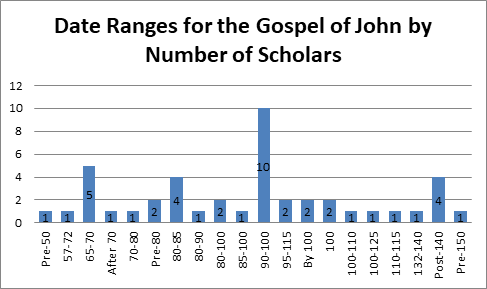
            Indeed, most of the dates suggested by different scholars fall somewhere between the years 80-100, with different preferred ranges.  According to David Croteau (Liberty University), these include 80-85 (Carson, Köstenberger and others), 80-90 (Godet), 80-100 (Hendriksen), and 90-100 (Brown, Witherington and many others).[7]  For his own part, Croteau favors a date between 80-100 but “with the most likely time being toward the earlier side of that range”.[8]  Here is a graphical representation of the different dates given, according to Croteau’s list,[9] which shows the general consensus for a date sometime around the end of the first century (most favor a date between 90-100).  This also shows how difficult it is for scholars to come to any agreement on what the date actually was:
John - Graph 1
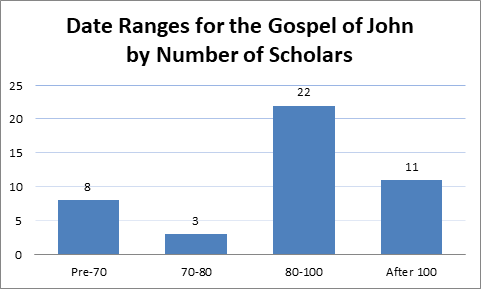
John - Graph 2
So it is clear that most scholars have preferred a date towards the end of the first century, and some prefer a date even into the early second century.[10]  In fact, more scholars favor a date after 100 CE than scholars who favor a pre-70 CE date.  So where does that leave the theory of the gospel being written before 70 CE?  One of the most vocal supporters of this theory is the contemporary NT scholar Daniel Wallace, who primarily rests his argument on the basis of one particular verse, John 5:2 (although it is certainly not the only reason).[11]

John 5:2 as Proof for a Pre-70 CE Date and Analysis
            John 5:2 states:
Now there is in Jerusalem near the Sheep Gate a pool, which in Aramaic is called Bethesda[a] and which is surrounded by five covered colonnades.” (NIV)
Wallace is particularly interested in the phrase “there is”, which in Greek is ἐστί (e-stē’).[12]  He argues that the author wrote in the present tense, which implies that the “Sheep Gate” of the temple (and thus the temple itself) was still standing in his day.  This matters because both the gate and the pool at Bethesda were supposed to have been destroyed by the Romans in 70 CE, along with the temple.  Thus, the argument goes, the gospel must have been written before the destruction of the temple and not after.

            While this argument may be plausible, there are still a few problems that cannot be explained.  First of all, just because the pool was in Jerusalem does not mean that it was destroyed along with the temple and its surrounding landmarks, or that it was destroyed and never rebuilt.  It is also possible that the author of the gospel could have simply been referring to the ruins of the pool.  Andreas Köstenberger, a Christian scholar, argues against using John 5:2 for dating the gospel to pre-70 CE on this basis.  He states that:
“…the reference could be to remains of the structure or the structure could have been rebuilt after being destroyed but prior to John’s writing…”[13]
This is also suggested by the text of the gospel itself, at least according to the New International Version translation.  Verse 3 is rendered as stating that people suffering from all manner of disabilities and illnesses “used to lie” in the pool, which implies that this was no longer the case in the author’s time:
“Now there is in Jerusalem near the Sheep Gate a pool, which in Aramaic is called Bethesda[a] and which is surrounded by five covered colonnades. Here a great number of disabled people used to lie—the blind, the lame, the paralyzed.”[14]
Admittedly, other translations render the verse differently, which would not imply the past tense.  For example, the English Standard Version (ESV) renders the verse as:
“In these lay a multitude of invalids–blind, lame, and paralyzed.”
So we need to dig deeper.  As Köstenberger suggested, what if the author was really referring to the ruins of the pool, something people in his time would have been familiar with?  The ruins of the pool were well-known even to later Christians.  According to Titus Kennedy:
“Eusebius, writing in the fourth century, mentions the “sheep pool” not the sheep gate, and he identified it as a place of twin pools (Eusebius, Onomasticon). The Bordeaux Pilgrim in the early fourth century calls them twin pools but mentions no gate, while other writings of the fourth and fifth centuries also mention the site of the pool, demonstrating that the ruins of the pool were visited during the Late Roman and Byzantine periods (Itinerarium Burdigalense; Cyril of Jerusalem; Jerome).”[15]
So if the ruins were known for centuries after Jesus (peace be upon him), it seems plausible that the gospel was referring to those ruins as well.  In fact, it was well known to later Christians up until the 7th century (during the Arab conquest), when the precise location of the pool was lost, only to be rediscovered by archaeologists in the 19th century. 
            Moreover, some alternate versions of the text do indeed show that the author was writing in the past tense in the important second verse.  According to Benson’s Commentary (emphasis in the original):
“[t]he Syriac seems to have read, ην, there was, as it is rendered in that version in the past time. Cyril, Chrysostom, and Theophylact favour this reading, as also does Nonnus.”[16]
If this reading was correct,[17] then it follows that the author was indeed referring to the ruins of the pool, since he was implying that the pool was no longer used for such purposes, which could only have happened after the destruction of Jerusalem by the Romans. 
           
 The other problem is that the text of John 5:2 doesn’t even mention the word “gate”.  The Greek text has been described as “rather obscure”,[18] which has resulted in most translations simply assuming that the author spoke of the “Sheep Gate”, even though other translations are also possible (such as “Sheep market”).  As the United States Conference of Catholic Bishops (USCCB) admits:
“[t]here is no noun with Sheep. “Gate” is supplied on the grounds that there must have been a gate in the NE wall of the temple area where animals for sacrifice were brought in…”[19]
According to D. Moody Smith, the obscurity may have been due to the simple matter of the author’s own uncertainty.  He explained that:
“…the roughness and difficulties arise from the fact that the narrative is here based on a more ancient tradition; perhaps the author himself was not fully conversant with the material he was using.”[20]
This may also explain the use of the phrase “there is in/at Jerusalem” in John 5:2.  It could merely have been a direct quote of the earlier source (see note #20) that the author was using and therefore not evidence that the entire gospel as it has reached us was actually written before the destruction of the temple in 70 CE.  Indeed, if the author was an eyewitness and new the landmarks of Jerusalem quite well, why is the description so vague?   
            Despite these issues, it is still worthwhile to study the Greek phrase that has created so many disagreements between scholars.  As previously stated, Daniel Wallace is supportive of the idea that the verse seems to be in the present tense, which indicates that the author was writing at a time when the temple and its various “gates” were still standing (i.e. before 70 CE).  But most other scholars are not convinced.  The reason is of course that there are other factors to consider when trying to date the gospel itself.  On the basis of these other factors, most scholars are simply not persuaded by one verse to date the entire gospel. 
            The Greek ἐστί ἐν (“there is in/at”) is in the present tense.[21]  But most scholars regard it as a “historical present tense”.  Jason Kerrigan quotes none other than Daniel Wallace himself (emphasis in the original) to explain that:
“[t]he historical present is used fairly frequently in narrative literature to describe a past event…The reason for the use of the historical present is usually to portray an event vividly, as though the reader were in the midst of the scene as it unfolds.  […] The historic present may be used to describe a past event, either for the sake of vividness or to highlight some aspect of the narrative.”[22]
So even though the Greek phrase is in the present tense, it does not necessarily mean that the author was literally writing in the present tense as if the temple and the pool at Bethesda were still standing in his time.  Köstenberger has argued that John 10:8 and 19:40 serve as examples, similar to 5:2, of historical presents of εἰμί (“to be” or “to exist”).[23]  Nevertheless, Thayer’s Greek Lexicon includes John 5:2 among other verses where εἰμί is translated as “to be found” or “there was” though it still defines the etymology of εἰμί as:
“[t]he first person singular present indicative…”[24]
But Wallace has objected to the association of John 5:2, 10:8 and 19:40 as examples of historical presents of εἰμί.[25]  Nevertheless, Köstenberger maintains that “it is certainly possible” to use “a past-referring use of the present tense of [εἰμί]”.[26]  Croteau also identifies John 5:2 as “probable for inclusion” among a list of historical presents in the Gospel of John.[27]  He also includes John 19:40 in this list, but not John 10:8.  Mavis Leung also identifies John 5:2 as a historical present, though he acknowledges that it does not “fit neatly” into the “three main verbal categories: speaking, seeing and moving”.[28]  However, he does identify it as one of three “past-referring indicative verbs”, the others being found in John 20:6 and 21:22.[29]  Of course, it should be borne in mind that there is considerable debate about what constitutes a historical present, as we can already clearly see.  Leung counts 165 examples in the Gospel of John, whereas other counts have varied from 162 to 166.[30]  For his part, Wallace counts 162 examples, not including 5:2 of course.[31]  So it does not seem like there will be a breakthrough regarding the date of the fourth gospel on the basis of this verse alone.  Thus, perhaps more attention should be paid to other pieces of evidence when trying to date the fourth gospel.     
            Much such “evidence” has been presented from both liberal and conservative scholars, with many Christians obviously trying to prove the earliest possible date.  But David Croteau, much to his credit since he is a Christian himself, shows more caution.  He rejects most of the arguments for a pre-70 date, and favors a date between 80-100.[32]  Though he lists several arguments for a post-70 date, there are a few which appear stronger than others.  These are listed here:
  1. Church fathers
            Ironically, Christian apologists tend to usually champion the record of the church fathers (Irenaeus, Justin Martyr etc.) as evidence of early Christian history, but in their zeal to assign the fourth gospel with as early a date as possible, some of them have decided to essentially ignore church tradition.  Though even some conservative scholars admit the “unreliability” of church tradition,[33] with regards to the fourth gospel, Croteau argues that “it is a relatively strong argument for dating the Gospel later rather than earlier”.[34]  D. Moody Smith pointed out that Irenaeus implied that “John the disciple” wrote the gospel “relatively late in the first century” during the reign of the Roman emperor Trajan,[35] which then favors a date almost near the end of the 1st century, since Trajan ruled from 98-117 CE.[36]  Also, as previously mentioned, Smith favored a date between 90-100.[37]          
  1. John 6:1 and the “Sea of Tiberias”
            This is perhaps one of the strongest arguments for a later date.  As Croteau explains, the city of Tiberias was founded by Herod Antipas on the western shore of the Sea of Galilee between 17-18 CE.[38]  The Compact Bible Dictionary puts the date of its founding around 20 CE,[39] and Smith puts it in the “early 20s CE”.[40]  Finally, Gary Burge put its founding in the year 26.[41]  Regardless of when it was founded, historians generally agree that the Sea of Galilee did not become widely known as the “Sea of Tiberias” until much later in the 1st-century,[42] and yet the fourth gospel uses the latter name in John 6:1 and 21:1.  Meanwhile, the Synoptic gospels exclusively refer to the “Sea of Galilee” and never the “Sea of Tiberias”.  This has led scholars to conclude that the fourth gospel must have been written much later, probably towards the end of the first century. 
            If the Gospel of John was written earlier (perhaps around the same time as the Synoptic gospels) or even a little later, we would not expect it to refer to the “Sea of Tiberias” instead of the “Sea of Galilee”.  It would be like if someone allegedly wrote a book about East Pakistan in 1947 (when Pakistan was founded) but referred to it as “Bangladesh”, which was the name it adopted in 1971 only after breaking away from West Pakistan.  One would have to conclude that the document was written much later than it was claimed.  The same conclusion would arise for the date of the fourth gospel (assuming if it was not redacted later) due to its reference to the Sea of “Tiberias” instead of the “Sea of Galilee”.                    
  1. John 20:28 and Domitian as Dominus et Deus
            The final piece of evidence to favor a late 1st-century date for the composition of the fourth gospel comes from John 20:28, in which Thomas referred to the resurrected Jesus as “My Lord and My God”.  Besides being one of the few verses in the entire New Testament where Jesus (peace be upon him) is clearly seen as divine (which puts the fourth gospel at odds with the Synoptics), this particular verse may be a good indicator for the date of the fourth gospel.  Scholars note that there just happened to be a conflict between Christians and the Roman Imperial Cult right around the end of the first century, and especially during the reign of Domitian who ruled the empire from 81-96 CE.[43]  According to the Roman historian Seutonius, Domitian required his subjects to refer to him as “Lord and God” (“Dominus et Deus”), whether in writing or direct conversation.[44]  So was John 20:28 an attack on Domitian’s imperial cult?  As Croteau explains, Domitian’s demands would not have begun until at least 81 CE, which:
“…likely accounts for why the Evangelist chose to include Thomas’s words…”[45]
Of course, there was nothing unusual in Domitian demanding that he be worshiped.  Previous emperors were also objects of worship.  As Professor Paul Trebilco states:
“…there is no evidence that Domitian demanded greater divine honours than his predecessors…”[46]
But by specifically demanding that he be referred to as “Lord and God” in written or verbal correspondence, Domitian was unique among the emperors.  Thus, it is possible that the author of the fourth gospel used Thomas’ reaction to the resurrected Jesus as a direct act of defiance against Domitian’s decree specifically or against the Roman imperial cult in general.[47] 
Conclusion
            Given these strong and compelling arguments, it seems prudent to stick with the current near-consensus regarding the date of the Gospel of John.  A date near the end of the 1st century indeed seems most likely.  We have seen that John 5:2 has other explanations, even if it was not meant to be in the historical present tense.  Moreover, other pieces of evidence strongly outweigh John 5:2 as far as determining the date. 
Addendum: A Brief Discussion of Authorship
            It was not the purpose of this article to discuss the issue of authorship, but it is an important issue.  Here, we will provide a brief overview.
            Church tradition maintains that the fourth gospel was written in Ephesus near the end of the 1st-century (a view which seems to align with the internal evidence, at least with regard to the time period),[48] but equally importantly, it maintains that the author was an eyewitness and disciple of Jesus (peace be upon him), whose name was John (the son of Zebedee).  But whereas the evidence for the date of composition seems to support church tradition, the evidence for authorship is flimsy at best.  In his commentary on the Gospel of John, the late D. Moody Smith explained that there are “as many reasons for doubting Johannine authorship as for embracing it”.[49] 
            First and foremost is the fact that the gospel does not state who the author is.  It is anonymous (more on this later).  Second, it is possible that the author was simply another “John” who later became confused with John the disciple.  It was claimed by Eusebius that Papias had claimed that the author was a certain “John the Elder”, who had known Jesus and heard him teach.[50]  Yet even this theory clearly suffers from the same problem as claiming that the author was John the son Zebedee.  It is all hearsay.  Smith refers to it as “at best a reasonable conjecture based on bits and pieces of evidence”.[51] 
            Another difficulty in assigning authorship to John is the claim that he wrote the gospel while residing in Ephesus.  Here, church tradition seems to have muddied the water.  While Irenaeus claimed the gospel was written in Ephesus, an earlier source, Ignatius of Antioch, did not mention that John resided at Ephesus at any time.  Smith observed that Ignatius “makes a great deal of the apostle Paul’s residence there, but, strangely, does not mention John”.[52]  To make matters worse, neither the New Testament nor any early 2nd-century Christian document puts John in Ephesus.[53]
            Finally, in an interesting analysis of chapter 20, Smith argued that the author intentionally remained anonymous.  Smith also surmised that if any of the disciples of Jesus qualified as the “beloved disciple”, it would have been Thomas, not John.[54]  Since chapter 21 seems to be a later addition,[55] and since Thomas is the last disciple mentioned at the end of chapter 20, it follows then he should qualify as the “beloved disciple”, at least in the “original” ending of the gospel.  Even if chapter 21 was the original ending, Smith, quoting David R. Beck (who believed 21:24-25 was the end of the gospel), notes that there is simply no specific disciple who is identified as the “beloved disciple”, so that “he remains anonymous, as the evangelist intended”.[56]  But if the author really was John the son of Zebedee or any other disciple, why did he go out of his way to remain anonymous?  If anything, it would bolster the credibility and authority of the gospel to directly name a specific disciple, but instead, the author deliberately decided to be anonymous.  It does not make much sense.  Therefore, in the absence of any conclusive evidence, the theory of Johannine authorship of the fourth gospel stands on thin ice.  Most likely, it was just a misattribution, as with the Synoptics.
And Allah (Glorified and Exalted be He) knows best!

Source