Ask a Trinitarian for evidence of the divinity of Jesus and they will undoubtedly direct you to Gospel of John. In a
previous article
we saw how any such evidence put forward from this Gospel is ambiguous
at best and often taken out of context or misinterpreted. Remove the
Gospel of John from the New Testament equation and there is very little
left in the Trinitarian’s armoury to appeal to for evidence of the
divinity of Jesus. If you take away this Gospel, any Biblical foundation
for the Trinity, ambiguous or otherwise, comes crashing down. So from a
Trinitarian’s perspective the stakes for the Gospel of John are very
high. This article is going to show that the Gospel of John is not a
reliable historical account of the life and teachings of Jesus:
1. Lack of early evidence.
Dating the Gospel of John is no easy task. For a time, particularly
in the early part of the 20th century, scholars believed that John was
written in the mid-second century. The discovery and publication in the
1930s of a papyrus fragment known as P52 changed everything:
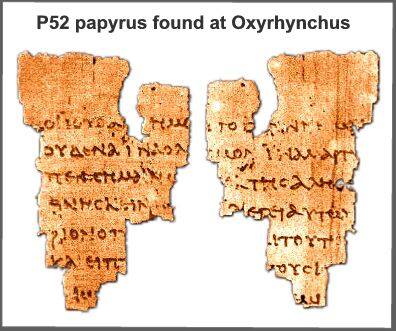
P52 is a small scrap about the size of a credit card and represents
the earliest physical evidence that exists for the Gospel of
John. Initial dating of P52 placed it at around 125 CE. This initial
dating has played a large part in dating the original writing of John to
80 – 95 CE. The theory is that for the Gospel of John to have been
copied and made its way to Egypt, where P52 was found, a date no later
than the first decade of the 2nd century must be presumed for the
original writing of the Gospel. However, recent re-examinations of P52
suggest that this date is too early [1], by approximately 80-100 years.
This would place the fragment well in the 3rd century, nearly 200 years
after Jesus.
All of the dates discussed so far have been obtained by comparing the
handwriting of P52 to datable scripts, a technique known as
palaeographic dating. As you can imagine, paleography is not the most
effective method for dating texts as this type of dating method gives a
relative, not absolute, date. Thus, P52 cannot be used as the sole basis
for settling the question of when the Gospel was originally written. We
can look into the citations from the gospels, as found in the writings
of the earliest Fathers of the Church, to establish a lower limit of
when the Gospel was originally written.
Based on this, the Gospel does not emerge clearly in the historical
record until the end of the 2nd century. Justin Martyr (100 – 165 CE)
was an early Christian apologist and is regarded as the foremost
interpreter of the theory of the Logos, a theology that is also found in
John’s Gospel. In the 2nd century Justin Martyr advocated a logos
Christology without citing John’s Gospel explicitly. Such an omission by
Justin would seem strange if the Gospel of John had already been
written and was in circulation. Neither was John’s Gospel known to the
bishop Polycarp. The letter of Polycarp to the Philippians, generally
thought to be from around 135 CE, never quotes from John, and never even
alludes to it. Yet other New Testament writings are quoted abundantly
in his letter. According to church history, Polycarp studied under the
disciple John and yet doesn’t once quote the Gospel of John in his
writings, even though he quotes the Gospels of Mark, Matthew and Luke.
This is incredible, the one person whose Gospel he should have written
about and he didn’t. There’s really no explicit attestation for John
until the bishop Irenaeus, late in the 2nd century.
In conclusion, the manuscript and historical evidence for the Gospel
of John taken together points us to a late 2nd century date for when the
Gospel was first written. This would mean that it’s impossible that a
disciple of Jesus was the author as the disciples of Jesus would have
long since passed away. Rather it is the work of a much later writer,
and for this reason we must reject it.
2. The fabricated story of the adulteress.
John 8:2-11 is the story of a woman that is about to be stoned on the
accusation of adultery. In these verses Jesus, when questioned about
her punishment, utters the famous words “Let he who is without sin cast
the first stone”:
At dawn he appeared again in the temple courts,
where all the people gathered around him, and he sat down to teach them.
The teachers of the law and the Pharisees brought in a woman caught in
adultery. They made her stand before the group and said to Jesus,
“Teacher, this woman was caught in the act of adultery. In the Law Moses
commanded us to stone such women. Now what do you say?” They were using
this question as a trap, in order to have a basis for accusing him.
But Jesus bent down and started to write on the ground with
his finger. When they kept on questioning him, he straightened up and
said to them, “Let any one of you who is without sin be the first to
throw a stone at her.” Again he stooped down and wrote on the ground.
At this, those who heard began to go away one at a time, the
older ones first, until only Jesus was left, with the woman still
standing there. Jesus straightened up and asked her, “Woman, where are
they? Has no one condemned you?”
“No one, sir,” she said.
“Then neither do I condemn you,” Jesus declared. “Go now and leave your life of sin.”
This story is unique to John, it is absent from the Gospels of Mark,
Matthew and Luke. It turns out that it is a later addition as the
earliest New Testament manuscripts do not contain it. In fact the story
does not even exist in any manuscripts before the 5th century, and the
vast majority of those prior to the 8th century lack the story [2]. Here
is a footnote regarding the story from the New International Version of
the Bible:
The earliest manuscripts and many other ancient
witnesses do not have John 7:53—8:11. A few manuscripts include these
verses, wholly or in part, after John 7:36, John 21:25, Luke 21:38 or
Luke 24:53.
Christians may claim that these verses have no theological
implications, and therefore it doesn’t matter that they are a
fabrication. However this is not the case, because these verses are one
of the few places in the New Testament that suggest Jesus sought to end
the Mosaic laws dealing with crime and punishment. Given this strong
evidence of tampering in John’s Gospel, we must reject it as the pure
word of God and take it for what it is: the corrupted word of man.
For more information on fabrications in the New Testament, see this article
here.
3. Very different to Synoptic Gospels.
Of the four New Testament Gospels, the Gospel of John is in a class
by itself. The Gospels of Mark, Matthew and Luke include many of the
same stories, often in the same sequence, and similar wording, hence
scholars classify these gospels as Synoptic, meaning “giving an account
of the events from the same point of view or under the same general
aspect” because they have a large degree of overlap. They stand in
contrast to John, whose content is comparatively distinct – in fact over
90% of its material cannot be found in the Synoptics. Here are some
examples:
i. The spear piercing the side of Jesus.
“Instead, one of the soldiers pierced Jesus’ side with a spear, bringing a sudden flow of blood and water.” [John 19:34]
Scholars generally believe today that the spear thrust that pierced
Jesus, a story found only in John’s Gospel, is not historical. It is an
embellishment introduced by John for his own theological reasons,
possibly to make sure that everyone would know that Jesus died on the
cross. Take away the spear thrust and there is nothing in the Gospels
that would have resulted in the death of Jesus. Crucifixion doesn’t
actually kill a person by itself, what kills a person is the shock and
exhaustion resulting from prolonged hanging on the cross, sometimes a
few days. According to the Gospel records Jesus was only on the cross
for a few hours.
ii. The guards prostrating to Jesus.
The Synoptics paint the picture of Jesus that is reluctant to be
crucified. For example they all mention Jesus begging God to be saved
from death when he is in the Garden of Gethsemane. Luke even has Jesus
sweating drops of blood just before his arrest. All of this is in stark
contrast to John, who portrays Jesus as willingly handing himself over
to the authorities:
So Judas came to the garden, guiding a detachment
of soldiers and some officials from the chief priests and the
Pharisees. They were carrying torches, lanterns and weapons.
Jesus, knowing all that was going to happen to him, went out and asked them, “Who is it you want?”
“Jesus of Nazareth,” they replied.
“I am he,” Jesus said. (And Judas the traitor was standing
there with them.) When Jesus said, “I am he,” they drew back and fell to
the ground.
[John 18:3-6]
Remarkably in John’s portrayal of the Garden of Gethsemane there is
no mention of any of these incidents from the Synoptics. John seems to
be concerned with magnifying the power of Jesus: from the outset Jesus
is in charge, just his voice is enough to cause the soldiers to retreat
and fall prostrate on the ground.
It is strange to think that the authors of the Synoptics would not
have been aware of incidents such as the spear piercing the side of
Jesus and the soldiers prostrating to him in the Garden of Gethsemane,
had they really taken place. It is even more inconceivable that they
would have intentionally omitted such remarkable accounts from the
Synoptics. One must therefore conclude that such stories are later
embellishments by whoever authored John.
4. Contradicts other Gospels.
The various Gospel accounts of the resurrection are so different that
it’s hard to know what to focus on, but the visit of Mary Magdalene to
the tomb of Jesus is central. Here is Matthew’s account of the tomb
visit:
“Now after the Sabbath, toward the dawn of the
first day of the week, Mary Magdalene and the other Mary went to see the
tomb. And behold, there was a great earthquake, for an angel of the
Lord descended from heaven and came and rolled back the stone and sat on
it” [Matthew 28:1-2]
But the angel said to the women, “Do not be afraid, for I
know that you seek Jesus who was crucified. He is not here, for he has
risen, as he said. Come, see the place where he lay. Then go quickly and
tell his disciples that he has risen from the dead, and behold, he is
going before you to Galilee; there you will see him. See, I have told
you” [Matthew 28:5-7]
So they departed quickly from the tomb with fear and great
joy, and ran to tell his disciples. And behold, Jesus met them and said,
“Greetings!” And they came up and took hold of his feet and worshiped
him. [Matthew 28:8-9]
So, in Matthew’s account Mary Magdalene is presented as having seen
an angel at the tomb and heard the angel announce the resurrection of
Jesus. After which she actually encountered Jesus as she was running
away from the tomb in order to inform the disciples about what had
happened.
Now here is John’s account of the tomb visit:
Now on the first day of the week Mary Magdalene
came to the tomb early, while it was still dark, and saw that the stone
had been taken away from the tomb. So she ran and went to Simon, Peter
and the other disciple, the one whom Jesus loved, and said to them,
“They have taken the Lord out of the tomb, and we do not know where they
have laid him” [John 20:1-2]
In John’s Gospel, however, Mary Magdalene is presented as having
found the tomb empty, after which she ran to the disciples and told them
that the body of Jesus had been stolen.
The problem is obvious: if Mary Magdalene met Jesus at the tomb, as
Matthew says, then why does she report that the body had been stolen
according to John?
Since it’s important to have a firm grasp of the chronological
sequence of events as described in Matthew and John, I have summarised
the key information in a diagram (please click on picture to enlarge):

Why is it that when it comes to a relatively trivial matter like
Jesus riding into Jerusalem on a donkey, all four Gospels corroborate
one another (“On a donkey and a colt” [Matthew 21:5-7], “on a colt”
[Mark 11:7]; [Luke 19:35], “on a young donkey” [John 12:14]); but the
bedrock of the Christian faith, the resurrection, contains
contradictions?
Some Christians may argue that these differences in the Gospel
accounts are the expected result of reports from a variety of witnesses,
but all testifying to the same essential fact—Jesus was raised from the
dead. Sometimes the analogy of an automobile accident is suggested.
When eyewitnesses report what they saw each reflects a particular
perspective, and there are always differences as to details, but the
essential facts related to the accident are clear. Such an analogy fails
in the case of the Gospels, as Christians make the claim that these are
inspired writers. If the author of John’s Gospel can’t even get the
basic details right about the most important aspect of the life of
Jesus, his resurrection according to the New Testament, then it casts
serious doubt on the author being an inspired eyewitness of the life of
Jesus.
For more information on this contradiction, see this article
here.
5. Rejected as a historical account by conservative Christian scholarship.
According to Mark, Matthew and Luke, the Last Supper appears to have
been the Passover meal. On the other hand, John’s Gospel seems to tell
us that Jesus died before the Passover meal. It’s necessary to quote
Mark at some length to show that, for him, the Last Supper was the
Passover:
And on the first day of Unleavened Bread, when
they sacrificed the Passover lamb, his disciples said to him, “Where
will you have us go and prepare for you to eat the Passover?” And he
sent two of his disciples and said to them, “Go into the city, and a man
carrying a jar of water will meet you. Follow him, and wherever he
enters, say to the master of the house, ‘The Teacher says, Where is my
guest room, where I may eat the Passover with my disciples?’ And he will
show you a large upper room furnished and ready; there prepare for us.”
And the disciples set out and went to the city and found it just as he
had told them, and they prepared the Passover. And when it was evening,
he came with the twelve. And as they were reclining at table and eating,
Jesus said, “Truly, I say to you, one of you will betray me, one who is
eating with me” [Mark 14:12-18]
These verses certainly give the impression that the meal being eaten
is the Passover meal. The disciples ask where the Passover meal is to be
eaten; they go there; they prepare; later Jesus arrives; and they do
indeed eat a meal. Luke is even more explicit that Jesus fully expected
to eat the Passover meal:
So Jesus sent Peter and John, saying, “Go and prepare the Passover for us, that we may eat it” [Luke 22:8]
Now, John also indicates that Jesus had a last meal with his
disciples. But, oddly, we’re told his final meal took place before the
festival of Passover:
“It was just before the Passover Festival. Jesus
knew that the hour had come for him to leave this world and go to the
Father. Having loved his own who were in the world, he loved them to the
end. The evening meal was in progress…” [John 13:1-2]
John also says that, as the Last Supper was getting started, Jesus sent Judas Iscariot away:
Then after he had taken the morsel, Satan entered
into him. Jesus said to him, “What you are going to do, do quickly.”
Now no one at the table knew why he said this to him. Some thought that,
because Judas had the moneybag, Jesus was telling him, “Buy what we
need for the feast,” or that he should give something to the poor. So,
after receiving the morsel of bread, he immediately went out. And it was
night. [John 13:27-30]
This indicates that the group did not yet have what they needed for
the Passover feast, which would mean the feast was yet to come. Further
evidence for this is provided by John 18:28, where Jesus’ accusers were
delivering him to Pilate:
Then they led Jesus from the house of Caiaphas to
the governor’s headquarters. It was early morning. They themselves did
not enter the governor’s headquarters, so that they would not be
defiled, but could eat the Passover.
Finally, John explicitly states that Jesus was crucified on the day of preparation for the Passover:
Now it was the day of Preparation of the
Passover. It was about the sixth hour. He said to the Jews, “Behold your
King!” They cried out, “Away with him, away with him, crucify him!”
Pilate said to them, “Shall I crucify your King?” The chief priests
answered, “We have no king but Caesar.” [John 19:14-15]
Remember that in the other Gospels, Jesus actually eats the Passover
with his disciples before his arrest. John’s timing of the story is
different. Why did John alter the story? We find a clue in John’s
writings when he refers to Jesus as the “Lamb of God”:
The next day John saw Jesus coming toward him and
said, “Look, the Lamb of God, who takes away the sin of the world!”
[John 1:29]
It’s crucial to note that John is the only Gospel that identifies
Jesus as the “Lamb of God”. John’s Gospel thus portrays Jesus as the
Passover lamb, slaughtered on the day of preparation of Passover, whose
shed blood somehow brings salvation, just as the blood of the Passover
lamb brought salvation to the children of Israel so many centuries
before. For John, Jesus was the Lamb of God – he died at the same time,
in the same place (Jerusalem), and at the hands of the same people (the
Jewish priests) as the Passover lambs. In other words, John has told a
story that is not historically accurate, but is, in his judgement,
theologically true.
Thus we can see that the Gospel of John is not writing about the
historical Jesus. John alters the day of the Crucifixion to portray
Jesus as the Passover lamb, he alters the story to make a theological
point. This is one of the many reasons why New Testament scholars
conclude that the Gospel of John is not historically accurate. In fact
if you read the works of New Testament scholars you will notice that
they hardly ever cite the Gospel of John in their research on the
historical Jesus. It’s not just liberal scholars saying this – even
conservative, Bible-believing Christian scholars no longer believe that
Jesus actually said the words attributed to him in John. Sadly, most
Christians are unaware of the findings of their own scholars.
Here I will cite some top New Testament scholars and their assessment
of this problem of John. These academics are not particularly ‘liberal’
and they are representative of the broad consensus of biblical
scholarship:
i. British biblical scholar and Anglican priest Christopher Tuckett,
in his book “Christology and the New Testament”, has this to say:
“In terms simply of historical reliability or
‘authenticity’, it seems impossible to maintain that both John and the
synoptics [Mark, Matthew and Luke] can be presenting us with equally
‘authentic’ accounts of Jesus‘ own life. By ‘authentic’ accounts I mean
here historically accurate representations of what Jesus himself
actually said and did. The theological ‘authenticity’ of John’s account
is quite another matter. The differences between the two are too deep
seated and wide ranging for such a position to be sustainable. If there
is a choice, it is almost certainly to be made in favour of the synoptic
picture, at least in broadly general terms. The picture John then
presents us with is a view of the Jesus tradition which has been heavily
coloured and influenced by John and his own situation.” [3]
ii. Evangelical scholar Professor Richard Bauckham in his recent book
“Jesus and the Eyewitnesses: The Gospels as Eyewitness Testimony”
argues that the fourth Gospel stems from an eyewitness to the ministry
of Jesus, namely, the disciple John. At the same time, however, Bauckham
also acknowledges the differences between the fourth gospel and the
Synoptics and argues that John is a more reflective and a highly
interpreted account of the life and ministry of Jesus. He concludes:
“All scholars, whatever their views of the
redactional work of the Synoptic Evangelists and of the historical
reliability of the Gospel of John, agree that the latter presents a much
more thoroughly and extensively interpreted version of the story of
Jesus.” [4]
iii. Here in a debate the evangelical apologist and New Testament
scholar Mike Licona concedes that John is not a historical account of
Jesus:
https://www.youtube.com/watch?feature=youtu.be&a=&v=e8itdKWa3Ko
6. The disciple John is said to be illiterate and uneducated.
The Book of Acts has this to say about some of the disciples, including John:
When
they saw the courage of Peter and John and realized that they were
unschooled, ordinary men, they were astonished and they took note that
these men had been with Jesus. [Acts 4:13]
Note how the New Testament describes some of the disciples, including
John, as “unschooled” and “ordinary”. That is the New International
Version (NIV), other versions of the Bible are far less flattering:
Now when they saw the boldness of Peter and John, and perceived that they were unlearned (agrammatos) and ignorant (idiōtēs) men, they marvelled; and they took knowledge of them, that they had been with Jesus. [KJV]
If we look to the original Greek, we will see that the actual meaning
is far worse (the following is taken from Strong’s Bible Dictionary):
Agrammatos – illiterate, without learning.
Idiōtēs – an unlearned, illiterate, man as opposed to the learned and educated: one who is unskilled in any art.
These Greek words are where we derive the English words ‘agrammatism’
(meaning “the inability to form sentences by virtue of a brain
disorder”) and ‘idiot’ (meaning “
a foolish or senseless person“).
Please note that it is not the intention of the author of this
article to offend the reader. If the disciples of Jesus really were
unschooled and ordinary, to take the more respectful rendering of the
Greek, then this is nothing to be ashamed of. Very few people at the
time of Jesus could read and write, with the typical literacy rate of
first century Palestine being about 3%, according to Professor of Jewish
studies Catherine Hezser who did the most thorough examination of
literacy in Palestine. This was even still the case all the way into the
9th century at the time of Prophet Muhammad (peace be upon him). But to
make the claim that this same disciple is the author of the Gospel of
John, a text that is written in highly eloquent Greek and tackles
complex theological issues such as the nature of the Logos, is
unreasonable. It is clear that the Gospel was not written by the
disciple John, who would be incapable of doing so, but rather a later
unknown author who was highly skilled in Greek philosophy, rhetoric and
literature.
7. Multiple authorship.
The single authorship of the John’s Gospel is highly doubtful.
Firstly, there is a questionable switch between John chapters 20 and 21.
Chapter 20 seems to come to an abrupt halt, as the author declares his
reasoning for the composition of the Gospel. Notice the statement that
not all of the miracles which Jesus performed are recorded:
“Jesus performed many other signs in the presence
of his disciples, which are not recorded in this book. But these are
written that you may believe that Jesus is the Messiah, the Son of God,
and that by believing you may have life in his name” [John 20:30-31]
These last verses of chapter 20 seem to wrap up the Gospel in an
abrupt, yet reasonable manner. Oddly, the very next chapter contains an
account of yet another miracle:
Early in the morning, Jesus stood on the shore,
but the disciples did not realize that it was Jesus. He called out to
them, “Friends, haven’t you any fish?” “No,” they answered. He said,
“Throw your net on the right side of the boat and you will find some.”
When they did, they were unable to haul the net in because of the large
number of fish. [John 21:4-6]
So, the addition of chapter 21 seems to come at an odd time. Perhaps
the original author did not finish the Gospel of John? The single
authorship of the John’s Gospel is also questionable when we analyse the
use of language in chapter 21. Toward the end of chapter 21, two verses
seem to close the Gospel once again:
“This is the disciple who testifies to these
things and who wrote them down. We know that his testimony is true.
Jesus did many other things as well. If every one of them were written
down, I suppose that even the whole world would not have room for the
books that would be written” [John 21:24-25]
Compare those two closing verses with the closing verses 30-31 of the
previous chapter – the Gospel effectively has two endings, which are
both very similar. This makes it seem that one of them is redundant.
Finally, note the use of the third person narrative in verse 24 below:
“This is the disciple who testifies to these things and who wrote them down. We know that his testimony is true.”
This leads the reader to believe that the author himself did not
write this particular statement. Further confusion comes when the use of
the word “we” comes into play, which indicates that the author is no
longer one person. Perhaps a community of believers finished the book
for John. Scholars have added the language and word choice to their
argument that chapter 21 of the Gospel of John came from an outside
source. The problem is that the identity of these multiple authors, and
the date when they added to the Gospel, is unknown.
8. Jesus is portrayed as a Greek.
The figure of Jesus presented in John is different, and indeed
irreconcilable, with that presented in the Synoptic Gospels: in the
Synoptic Gospel accounts Jesus is a recognisably Jewish figure. Yet the
figure of Jesus presented in John seems to have ‘lost’ his Jewishness.
For example when addressing the Jews he speaks of the Mosaic Law as
“your Law” and “their Law” as though it wasn’t his on numerous
occasions:
“In your own Law it is written that the testimony of two witnesses is true.” [John 8:17]
Jesus answered them, “Is it not written in your Law, ‘I have said you are gods’” [John 10:34]
But this is to fulfill what is written in their Law: ‘They hated me without reason.’ [John 15:25]
His style of preaching is also different: whereas in the Synoptic
Gospels he preaches in narrative parables and in short compact sayings,
in John the method is with long discourses – Jesus has effectively
become a Greek. If the Gospel of John were read in isolation then one
would never guess that the parable was a common teaching method of his
(John 15:1-8 being a rare example of a parable). It’s interesting to
note that none of the parables in the other Gospels are found in John;
they are omitted.
9. Third person narrative.
None of the Gospel authors make the claim of being firsthand
eyewitnesses of the life of Jesus. However if the Gospel of John is to
be considered an eyewitness account, then one would expect it to be
written from a first person perspective. Yet the author employs a third
person narrative throughout the Gospel, indicating that it was not them
who experienced the events they are writing about, but rather is
relating events they heard from someone else.
Another important point is that John the Evangelist has been named
consistently in the writings of early church fathers to be the person
referred to as the one whom “Jesus loves”. This phrase is used six times
throughout the Gospel of John. What we find is that the Gospel of John
refers to this disciple who “Jesus loves” in the third person so the
author obviously can’t be John:
One of them, the disciple whom Jesus loved, was reclining next to him. [John 13:23]
Christians may argue that this was just the style of ancient
literature and therefore it was perfectly normal for people to write
about themselves in the third person. But this is not the case, as the
author of the Gospel of Luke (dated by scholars to have been written in
the same time frame as John) writes in the first person narrative:
“Many have undertaken to draw up an account of
the things that have been fulfilled among us, just as they were handed
down to us by those who from the first were eyewitnesses and servants of
the word. With this in mind, since I myself have carefully investigated
everything from the beginning, I too decided to write an orderly
account for you, most excellent Theophilus, so that you may know the
certainty of the things you have been taught.” [Luke 1:1-4]
Moreover the author of the Epistles of John, claimed by Christians to
be the same author of the Gospel of John, also writes in the first
person:
“That which was from the beginning, which we have
heard, which we have seen with our eyes, which we have looked at and
our hands have touched—this we proclaim concerning the Word of life.” [1
John 1]
Clearly, the Gospel of John was not written by a firsthand witness of
Jesus, but rather a later author who had no connection with the events
it narrates, hence the detached third person narrative – much like that
of a history book – employed throughout the Gospel.
10. It has Gnostic tendencies.
The Gospel of Thomas is a well-preserved early Christian,
non-canonical sayings-gospel which many scholars believe provides
insight into the oral gospel traditions. It was discovered near Nag
Hammadi, Egypt, in December 1945, in one of a group of books known as
the Nag Hammadi library. One of the key things that set this Gospel part
from the canonical Gospels is that it does not mention the crucifixion
and resurrection of Jesus.
This is obviously disturbing for mainstream Christianity as without
these stories the very foundation for Paulian Christianity comes
crashing down. Hence Christians are inclined towards attempting to
discredit Thomas by writing it off as a later Gnostic text, a group they
say is heretical. Now you may be wondering what the Gospel of Thomas
has to with the subject of this article, the Gospel of John. The answer
is that it reveals a double standard, as the very reasons that
Christians use to reject the Gospel of Thomas also apply to the Gospel
of John:
i. The claim that the Gospel of Thomas is a heretical Gnostic text.
Arguably the best known and most influential passage dealing with
Christology in the New Testament is the Prologue of the Gospel of John,
1:1-18. The first eighteen verses of John are typically called the
“Prologue” because they are clearly set apart from the rest of the
Gospel. The first thing to note is that we are not dealing with a prose
narrative here, but with something that looks like a poem. The passage
is written in a highly poetic style that’s not found in the rest of the
Gospel of John. These verses also contain key concepts not found in the
rest of the Gospel, such as Jesus being “the Word” made flesh. Jesus is
called the “logos” twice in the prologue and never anywhere else in the
Gospel of John (or even the entire New Testament for that matter). These
are some of the reasons why scholars widely believe that the author of
the John’s Gospel appended these verses as a Prologue, possibly after
the rest of the book was written.
The reason why it’s important to highlight this is that the ideas
contained in the prologue to John are Gnostic in nature, the very thing
that Christians use to reject the Gospel of Thomas. It’s quite telling
that the early Gnostics assigned profound significance to the Gospel of
John – especially to the prologue. An historic eye-witness who reported
on this was the early Church Father Irenaeus. In his book “Against
Heresies” Irenaeus quotes from a lengthy Gnostic commentary on the
prologue of John [5]. According to this source the Gnostics believed the
opening verses explicitly mentioned the names of several primeval
entities or “Aions” which emanated forth in succession from the Father.
These Aions have the following names in Greek and they are important
figures in Gnostic myth: Monogenes (also called Arche), and Aletheia,
Logos, Zoe, Anthropos and Charis. These are common names in Gnostic myth
as reported by Irenaeus. It just so happens that these very names are
also mentioned in the opening verses of John:
In John 1:1–18 the following Aions are revealed by name: (as translated from the ancient Greek text of John):
a) the “Beginning” or Arche, in which was
b) the Word (Logos), in which was
c) Life (Zoe), which was the “light” of
d) Man (Anthropon), which also signified and included
e) the Church (Ecclesia), and also
f) Grace (Charis), and
g) Truth (Aletheia)
Arche was also known as the Only-begotten Son (Monogenes), being the first and only-begotten Son of
h) the unknown Father (Jn. 1:18, 17:25).
Stated simply, the theology in John is anything but “orthodox”; the
unorthodox themes in John indicate that, in its original form, the
Gospel of John may well have been the earliest of the Gnostic
Gospels. The case can actually be made that John has a dual theology.
There is one part of John that echoes the Jewish tradition, and then
there is another part that really resembles some form of Gnosticism,
possibly adopted from a popular Mandaean Gnostic dualism.
ii. The claim that the Gospel of Thomas is a much later text.
The argument here is that the Gospel of Thomas is a much later
writing which came after the canonical Gospels of Matthew, Mark, Luke
and John. Scholars differ on when the Gospel of Thomas was written. The
early camp dates the manuscripts to the second half of the 1st century,
making it contemporary to the canonical Gospels, and the late camp dates
Thomas to sometime after 100 CE, generally in the mid-2nd century. Even
if we assume this later dating, it still makes it earlier than John’s
Gospel, which as we covered in a previous section is dated to the late
2nd century. So the reality is that the Gospel of Thomas has a textual
history that is on par with, or in some cases superior than, the
canonical Gospels.
In summary, if Christians want to insist on rejecting the Gospel of
Thomas by writing it off as a later Gnostic work, then they have to be
consistent and reject the Gospel of John for the exact same reason as it
too has Gnostic tendencies.
CONCLUSION
All the evidence that can be examined about the Gospel of John points
to the same conclusion: it cannot be taken as a reliable historical
account of Jesus. Since the Gospel of John is the bedrock for
Trinitarians, often their go to book of the Bible in trying to find
support for the divinity of Jesus, this represents yet another damning
blow to the doctrine of the Trinity. Readers are encouraged to learn
about the true historical Jesus, who can only be found in the pure,
undistorted words of the Qur’an, God’s last and final revelation to
mankind:
http://manyprophetsonemessage.com/2013/12/16/jesus-peace-be-upon-him-in-islam/
References
1 – The Use and Abuse of P52: Papyrological Pitfalls in the Dating of
the Fourth Gospel, Brent Nongbri, Harvard Theological Review, 2005.
2 – Bruce Metzger, The Text of the New Testament: Its Transmission, Corruption, and Restoration, 4th ed. (2005), p. 320.
3 – Christopher Tuckett, Christology and the New Testament, chapter 9: ‘The Gospel of John’, pp.151-152.
4 – Richard Bauckham, Jesus and the Eyewitnesses: The Gospels as Eyewitness Testimony, p. 410.
5 – Irenaeus, Against Heresies, 1.8.5; J. Donaldson, Ante-Nicene Fathers, vol. 1, p. 328.
http://manyprophetsonemessage.com/2015/05/12/ten-reasons-why-we-must-reject-the-gospel-of-john/



 : Kalimatuh used
in this verse tells us that Sayyidna 'Isa (A.S) is the 'word' of
Allah. Commentators have given different meanings of this expression:
: Kalimatuh used
in this verse tells us that Sayyidna 'Isa (A.S) is the 'word' of
Allah. Commentators have given different meanings of this expression: or
'be' by Almighty Allah after which the child comes to exist. Since the
first factor is out of question in the case of Sayyidna 'Isa (A.S),
therefore, it was by attributio
or
'be' by Almighty Allah after which the child comes to exist. Since the
first factor is out of question in the case of Sayyidna 'Isa (A.S),
therefore, it was by attributio (the word of Allah). It means that he came into existence solely through the word:
  would mean that Almighty Allah delivered this word to Maryam (A.S) as
a result of which the birth of Sayyidna 'Isa (A.S) came to be.
would mean that Almighty Allah delivered this word to Maryam (A.S) as
a result of which the birth of Sayyidna 'Isa (A.S) came to be. (the glad tiding of Allah) and it refers to Sayyidna 'Isa (A.S). It
will be recalled that the glad tiding of the coming of Sayyidna 'Isa
(A.S) given to Maryam (A.S) by Almighty Allah through the angels
carries the expression: Kalimah or word:
(the glad tiding of Allah) and it refers to Sayyidna 'Isa (A.S). It
will be recalled that the glad tiding of the coming of Sayyidna 'Isa
(A.S) given to Maryam (A.S) by Almighty Allah through the angels
carries the expression: Kalimah or word:  (When the angels said, "O Maryam, Allah gives you the good news of a word ... 3:45).
  'She (Maryam) testified to the word of her Lord as true.' (66:12)
 (... and a spirit from Him.) in this verse. Worth attention here are
two aspects of our probe. Firstly, why has Sayyidna 'Isa (A.S) been
referred to as ruh or spirit? Secondly, since by saying 'from
Him' the spirit has been attributed to Almighty Allah what, then, would
be the sense of such an attribution?
(... and a spirit from Him.) in this verse. Worth attention here are
two aspects of our probe. Firstly, why has Sayyidna 'Isa (A.S) been
referred to as ruh or spirit? Secondly, since by saying 'from
Him' the spirit has been attributed to Almighty Allah what, then, would
be the sense of such an attribution? has been referred to in Surah Bani Isra'il in the wordings:
  (carried His servant) (17:1) where the attribution to Allah reflects honour given to him.
 (and thus We have revealed to you a spirit of Our Command - 42:52)
because the Holy Qur'an too blesses people with spiritual life.
(and thus We have revealed to you a spirit of Our Command - 42:52)
because the Holy Qur'an too blesses people with spiritual life.  (the possessor of a spirit from Him). However, since all rational
beings are equal as the possessors of a spirit, the distinction of
Sayyidna Isa
(the possessor of a spirit from Him). However, since all rational
beings are equal as the possessors of a spirit, the distinction of
Sayyidna Isa  (then, We blew Our spirit in her - 21:91) points out in this direction.
 (a spirit from Him). 'Allamah al-Waqidi came up with a rejoinder and recited another verse (45:13) of the Qur'an:
  (The meaning of the verse is that everything that there is in the heavens and the earth is from the same Allah where the word - minhu: from Him - serves to attribute everything to Allah) and said:
  (ruhim-minhu:
a spirit from Him) means, as you think, that Sayyidna 'Isa (A.S) is a
part of Allah, then, the verse I have just recited would mean that
every thing in the heavens and the earth is also a part of Allah?'
Thus, silenced, the Christian physician chose to become a Muslim.
(ruhim-minhu:
a spirit from Him) means, as you think, that Sayyidna 'Isa (A.S) is a
part of Allah, then, the verse I have just recited would mean that
every thing in the heavens and the earth is also a part of Allah?'
Thus, silenced, the Christian physician chose to become a Muslim. (And do not say "Three") is the state of the major sects among
Christians in which they were divided at the time of the revelation of
the.Qur'an. The doctrine of Trinity they adhered to was base on three
separate principles. One sect maintained that Masih is God and it is
God Himself who has appeared in the world in the form of Masih. The
second sect believed that Masih is the son of God while the third sect
claimed unity in trinity - the father, the son and Mary. Even this
group was split in two. The second group said that the Holy Spirit (Ruhul-Quds)
and not Sayyidah Maryam (Mary) was the third person (hypostasis).
So, these people acknowledged Sayyidna Masih (A.S) as the third of the
three. Therefore, all the three sects have been addressed, separately
and jointly in the Holy Qur'an whereby the Christians have been clearly
told that there is just one truth and that truth is that Masih (A.S)
is a human being born to Maryam (A.S), and a true Messenger of God.
Whatever is said beyond that is all false and ineffectual - whether it
be loaded with the excess of under-estimation, as believed by the Jews,
viz., God forbid, he was an imposter and fabricator: or, be a case of
the excess of over-estimation as believed by the Christians, viz., God
forbid, he is God or the son of God or the third of the three.
(And do not say "Three") is the state of the major sects among
Christians in which they were divided at the time of the revelation of
the.Qur'an. The doctrine of Trinity they adhered to was base on three
separate principles. One sect maintained that Masih is God and it is
God Himself who has appeared in the world in the form of Masih. The
second sect believed that Masih is the son of God while the third sect
claimed unity in trinity - the father, the son and Mary. Even this
group was split in two. The second group said that the Holy Spirit (Ruhul-Quds)
and not Sayyidah Maryam (Mary) was the third person (hypostasis).
So, these people acknowledged Sayyidna Masih (A.S) as the third of the
three. Therefore, all the three sects have been addressed, separately
and jointly in the Holy Qur'an whereby the Christians have been clearly
told that there is just one truth and that truth is that Masih (A.S)
is a human being born to Maryam (A.S), and a true Messenger of God.
Whatever is said beyond that is all false and ineffectual - whether it
be loaded with the excess of under-estimation, as believed by the Jews,
viz., God forbid, he was an imposter and fabricator: or, be a case of
the excess of over-estimation as believed by the Christians, viz., God
forbid, he is God or the son of God or the third of the three.
 (To
him belongs what is in the heavens and what is in the earth. And Allah
is enough to trust in.). The drive of the meaning is: When everything
has been created by Him, when everything falls under the domain of His
mastery and when everyone is a servant ofAllah, who and how could
anyone become His partner or associate or son? The fact is that
Almighty Allah is the dispenser of all our needs and the sole caretaker
of everyone's wants - He is universally and perennially sufficient, all
by Himself. He needs nobody. How, then, could He need to have a
partner or son?
(To
him belongs what is in the heavens and what is in the earth. And Allah
is enough to trust in.). The drive of the meaning is: When everything
has been created by Him, when everything falls under the domain of His
mastery and when everyone is a servant ofAllah, who and how could
anyone become His partner or associate or son? The fact is that
Almighty Allah is the dispenser of all our needs and the sole caretaker
of everyone's wants - He is universally and perennially sufficient, all
by Himself. He needs nobody. How, then, could He need to have a
partner or son? .
In this verse, the People of the Book have been asked not to indulge
in excess in matters relating to their Faith. Lexically, the Qur'anic
word:
.
In this verse, the People of the Book have been asked not to indulge
in excess in matters relating to their Faith. Lexically, the Qur'anic
word:  : al-Ghuluww means to cross the limits or transgress. In Ahkam al-Qur'an, Imam al-Jassas says:


 (that is, these people took their religious leaders as objects of
worship, other than Allah). It means that they had already been
excessive in making their prophet a God, then, they started worshipping
later-day religious leaders in the name of following the prophet!
(that is, these people took their religious leaders as objects of
worship, other than Allah). It means that they had already been
excessive in making their prophet a God, then, they started worshipping
later-day religious leaders in the name of following the prophet! (like these, like these) which means that one should do his or her ramy at Jamarat using average-sized pebbles litfe these. Then, he said:


