Saturday, April 13, 2013

Trinity & Elohim !

Elohim
 Trinitarians, in their trials to find "hidden clues" for the innovated trinity, may come with weird theories like: Elohim is plural so this implies that God is trinity !

The Truth is: In literal translation, Hebrew word for Elohim does signify a plurality, the word Elohim means GODS, this is the literal translation. So if we want to play the Trinitarian game, then we must be honest and translate Genesis 1:1 as follows:

In the Beginning Gods created the heavens and the earth (genesis 1:1)

So we are left with the reality of Gods, and if we go by this approach then they have become polytheists!
This proves that Trinitarians are polytheists, since they believe Elohim simply means a literal plurality, which by definition means they believe in Gods, not a God, but Gods in the plural.

Detailed explanation:

Elohim is the plural form of Eloah and appears closely related to El, which usually means "god", "God", or "mighty one".
But IF we were right to translate Elohim as a plural word, the Bible would teach us that in the beginning, "Gods" created the heavens and the earth (Gen. 1:1). The Bible would then support the idea that more than one God created the universe, spoke to Abraham, delivered Israel from bondage and continued dealing with them, etc., since Elohim is used throughout the "Old" Testament as God(s). But virtually no monotheist would profess that there is more than one God.

In Biblical Hebrew, a noun that is plural in form is not necessarily plural in meaning.
For instance, the Hebrew words chayim (chayeem, "life") and panim (paneem, "face", "presence", "countenance") are plural in form, but almost always singular in meaning. Another word, adon, "lord", "master", is often plural in form. In its plural form it is sometimes used of a single person - Abraham (Gen. 24:9-10), Joseph (Gen. 42:30,33), the king of Egypt (Gen. 40:1) and an anonymous "fierce king" under whose rule the Egyptians were prophesied to come (Isa. 19:4, NRSV). There are instances of other plural Hebrew words employed in the Hebrew Bible with singular meaning.

Equally striking is the fact that the same term, elohim, is used of the individual false gods.
Elohim is used of Dagon, the god of the Philistines (1 Sam. 5:7); of Chemosh, the god of Ammon and Moab (Jud. 11:24; 1 Kings 11:33); of Ashtarte (or Ashtoreth), the god(dess) of the Sidonians (1 Kings 11:33); of Milcom, another god of the Ammorites (1 Kings 11:33). In Smith's Bible Dictionary (NISBE) no plurality in any one of these gods is even hinted at. Additionally, in Nehemiah 9:18, elohim is used to refer to the single golden calf made by Israel in the wilderness.

Elohim is also used of single human figures. Moses in both Exodus 4:16 and 7:1 and the Messianic king in Psalms 45:6 (verse 7 in the Hebrew Bible) are each referred to as elohim.

What all this indicates is that in Hebrew, plural nouns in general and Elohim in particular do not always have plural meanings. In the case of the word Elohim, in fact, it would appear as though we should almost always understand it as singular in meaning unless the context indicates that "gods" are referred to.

Scholars are entirely familiar with these facts. The expressions "plural of majesty" or "plural of rank" or "intensive plural" are sometimes used to describe this phenomenon of language where the form of a word can be plural but its meaning is singular.

New International Version Study Bible:
"God created. The Hebrew noun Elohim is plural but the verb is singular, a normal usage in the OT when reference is to the one true God. This use of the plural expresses intensification rather than number and has been called the plural of majesty, or of potentiality."

Mercer Dictionary of the Bible :
"The plural Elohim is used frequently, a phenomenon sometimes called the majestic plural. Although the form is plural the one referred to or who is speaking is singular."

The New Catholic Encyclopedia:
"The Divine name ('Elohim) most frequently used in the Old Testament, a plural form of Eloah, which appears only in poetical books (34 of the 57 times in Job alone). The form Elohim, when used of the God of Israel, is a plural of majesty, signifying the one God who embodies in Himself all the qualities of divinity, and is almost always accompanied by singular verbs and adjectives."

HarperCollins' Bible Dictionary:
"Elohim is one of the three common generic names for God in the OT, occuring almost 2600 times. The term is a plural, probably of El or Eloah, hebrew words for "god", and on occassions means "gods" (e.g. Exod. 20:3). Most often it is a plural of majesty for israel's "God" (e.g. , Gen. 1:1) and thus is translated in the singular."

Similarly, When Allah in Quran uses the pronoun “We,” it does not mean that Muslims believe in more than one God, because the plural used here is the plural of respect or majesty and not numbers.

This can be clearly seen in the following Quranic verse:

وَمَا أَرْسَلْنَا مِن قَبْلِكَ مِن رَّسُولٍ إِلَّا نُوحِي إِلَيْهِ أَنَّهُ لَا إِلَٰهَ إِلَّا أَنَا فَاعْبُدُونِ
And We (i.e., Allah) sent not before you (i.e., Muhammad) any messenger except that We revealed to him that, “There is no deity except Me, so worship Me [alone].” (Qur’an, 21:25)

Re: 1 John 5:7 & refuting trinity

 Alleged Biblical Proof

"For there are three that bear record [ in heaven, the Father, the Word, and the Holy Ghost, and these three are one]."
1 John 5:7
Is this not a fair testimony to acknowledge the `Doctrine of Trinity'?

1. The text quoted does appear in the Kings James Version but has been omitted by most of the editors of the recent versions e.g. Revised Standard Version, New American Standard Bible, New English Bible, Phillips Modern English Bible, because the quoted text does not appear in the older Greek manuscripts.

Greek manuscripts
About 300 existing Greek manuscripts contain the book of I John. Of these manuscripts, only 4 (manuscript numbers 61, 629, 918, 2318) contain the disputed words of v.7. All four are very late manuscripts (16th, 14th or 15th, 16th, and 18th centuries A.D. respectively); none gives the Greek text exactly as it appears in printed Greek NTs, and all 4 manuscripts give clear evidence that these words were translated into Greek from Latin. Four additional manuscripts (88, 12th century; 221, 10th; 429, 16th; 636, 15th) have the disputed words copied in the margin by much later writers.
Ancient writers:
No Greek-speaking Christian writer before the year 1215 A.D. shows any knowledge of the disputed words. Not once are these words quoted in the great controversy with the Arians (over the Deity of Christ and the doctrine of the Trinity) in the 3rd and 4th centuries; they certainly would have been quoted if they had existed in any Greek manuscript of that period. The disputed words are quoted as Scripture only by Latin-speaking writers, and only after the middle of the 5th century A.D.
Ancient translations:
the disputed words are not found in any of the ancient translations of the NT made in the 2nd-10th centuries A.D.--Syriac, Coptic, Armenian, Georgian, Gothic, Ethiopic, Arabic, Slavic--except in Latin. The words are found in some manuscripts (but not the earliest) of the Old Latin version, and in many manuscripts of the Latin Vulgate (but not the earliest).

Conclusion: the evidence of every kind is consistent and clear: the disputed words of I John 5:7 have no claim as an original part of John's letter, but were introduced into Greek from Latin in the very late Middle Ages.

2. Renowned historian Edward Gibbon calls the addition a "Pious Fraud" in his famous history book `Decline and Fall of Roman Empire'.

3. Peakes commentary on the subject reads;
"The famous interpolation after "three witnesses" is not printed even in RSVn, and rightly. It cites the heavenly testimony of the Father, the logos, and the Holy Spirit, but is never used in the early trinitarian controversies. No respectable Greek MS contains it. Appearing first in a late 4th-cent. Latin text, it entered the Vulgate and finally the NT of Erasmus."
4. The scripture translator Benjamin Wilson gives the following explanation for this action in his "Emphatic Diaglott."

"This text concerning the heavenly witness is not contained in any Greek manuscript which was written earlier than the fifteenth century. It is not cited by any of the ecclesiastical writers; not by any of early Latin fathers even when the subjects upon which they treated would naturally have lead them to appeal to it's authority. It is therefore evidently spurious."

The Wycliffe Bible Commentary
The text of this verse should read, Because there are three that bear record. The remainder of the verse is spurious. Not a single manuscript contains the trinitarian addition before the fourteenth century, and the verse is never quoted in the controversies over the Trinity in the first 450 years of the church era. 8. The three witnesses are the spirit, and the water, and the blood: and these three agree in one. "The trinity of witnesses furnish one testimony" (Plummer, The Epistles, p. 116) namely that Jesus Christ came in the flesh to die for sin that men might live.

The New Bible Commentary: Revised:
"Notice that AV [the Authorized Version] includes additional material at this point. But the words are clearly a gloss [an added note] and are rightly excluded by RSV [the Revised Standard Version] even from its margins" (1970, p. 1269)

Dr. Neil Lightfoot, a New Testament professor ( How We Got the Bible, 2003, pp. 100-101).
"The textual evidence is against 1 John 5:7,"
"Of all the Greek manuscripts, only two contain it. These two manuscripts are of very late dates, one from the fourteenth or fifteenth century and the other from the sixteenth century. Two other manuscripts have this verse written in the margin. All four manuscripts show that this verse was apparently translated from a late form of the Latin Vulgate"

Theology professors Anthony and Richard Hanson, in their book Reasonable Belief: A Survey of the Christian Faith,
"It was added by some enterprising person or persons in the ancient Church who felt that the New Testament was sadly deficient in direct witness to the kind of doctrine of the Trinity which he favoured and who determined to remedy that defect . . . It is a waste of time to attempt to read Trinitarian doctrine directly off the pages of the New Testament" (1980, p. 171).

Hot Tip:
Notwithstanding the above rejections, the verse that follows the quoted text reads in KJV; "And there are three that bear witness in earth, the spirit, and the water, and the blood; and these three agree in one." (1John5:8).
Are these three witnesses "co-equal"? Can blood be substituted with water? Can water be regarded as the same in any respect with the Spirit? Just as the spirit, the blood and the water are three separate entities, so are the first three witnesses, namely; the Father, the Son (Word, Logos) and the Holy Spirit (Ghost).

Friday, April 12, 2013

Matthew 28:19 & trinity, Is it a valid proof ?

"Go therefore and make disciples of all the nations, baptizing them in the name of the Father and the Son and the Holy Spirit" (Matthew 28:19);
Does this not prove that the `Doctrine of Trinity' and its present day formula was communicated and promulgated in the bible ?

With all due respect, we tend to disagree in view of the following compelling evidences:-

1. `Peake's Commentary on the Bible' published since 1919, is universally welcomed and considered to be the standard reference book for the students of the Bible. Commenting on the above verse it records;
"This mission is described in the language of the church and most commentators doubt that the trinitarian formula was original at this point in Mt.'s Gospel, since the NT elsewhere does not know of such a formula and describes baptism as being performed in the name of the Lord Jesus (e.g. Ac. 2:38, 8:16, etc.)."

2. Tom Harpur, author of several bestsellers and a former professor of New Testament, writes in his book `For Christ's Sake';
 
"All but the most conservative of scholars agree that at least the latter part of this command was inserted later. The formula occurs nowhere else in the New Testament, and we know from the only evidence available (the rest of the New Testament) that the earliest Church did not baptise people using these words - baptism was "into" or "in" the name of Jesus alone."

3. Early Christians, such as scholars and historians (up to 350 years after Jesus’ departure), in their writings, and when quoting Matthew 28:19, give a different text than what we have today.

For example, when the Christian historian Eusebius of Caesarea (a.k.a. Eusebius Pamphili) (c. AD 263 – 339), who’s called “Father of Church History,” quoted Matthew 28:19 in his famous Ecclesiastical History, there was no triune formula in the verse.

The verse read,
 
Go ye and make disciples of all the nations in my name, teaching them to observe all things, whatsoever I commanded you.
He did not quote this verse in this form only once, but no less than 18 times in many of his works written between 300 and 336, namely in his long commentaries on the Psalms, on Isaiah, in his Demonstratio Evangelica and in his Theophany.

4. The quoted verse (irrespective of it being authentic or otherwise), does not indicate that the three names mentioned are “co-equal” in their status and were also “co-eternal” in the time frame. Unless these two important qualifications are acknowledged, the verse fails to endorse the fundamental belief and principle of the ‘Doctrine of Trinity’.Regardless of all that, there is nothing in the text which indicates that the Father, the Son and the Holy Ghost are one.Regardless of all that, there is nothing in the text which indicates that the Father, the Son and the Holy Ghost are one. The verse talks about three different essences mentioned together in conjunction, which indicates that they are different, distinct essences.


5. If the Father and His Son were both in "existence" from the Day One, and no one was, a micro second before or after, and, no one was "greater or lesser" in status, than why is one called the Father and the other His begotten Son?

6. Did the act of "Begetting" take place? If YES, where was the "Begotten Son" before the act? If NO, why call him the "Begotten Son"?

7.
The Encyclopedia of Religion and Ethics:
As to Matthew 28:19, it says: It is the central piece of evidence for the traditional (Trinitarian) view. If it were undisputed, this would, of course, be decisive, but its trustworthiness is impugned on grounds of textual criticism, literary criticism and historical criticism. The same Encyclopedia further states that: "The obvious explanation of the silence of the New Testament on the triune name, and the use of another (JESUS NAME) formula in Acts and Paul, is that this other formula was the earlier, and the triune formula is a later addition."

Edmund Schlink, The Doctrine of Baptism, page 28:
"The baptismal command in its Matthew 28:19 form can not be the historical origin of Christian baptism. At the very least, it must be assumed that the text has been transmitted in a form expanded by the [Catholic] church."

The Tyndale New Testament Commentaries, I, 275:
"It is often affirmed that the words in the name of the Father, and of the Son, and of the Holy Ghost are not the ipsissima verba [exact words] of Jesus, but...a later liturgical addition."

Wilhelm Bousset, Kyrios Christianity, page 295:
"The testimony for the wide distribution of the simple baptismal formula [in the Name of Jesus] down into the second century is so overwhelming that even in Matthew 28:19, the Trinitarian formula was later inserted."

The Catholic Encyclopedia, II, page 263:
"The baptismal formula was changed from the name of Jesus Christ to the words Father, Son, and Holy Spirit by the Catholic Church in the second century."

8. If the US president told someone "Go ye therefore, and speak to the Iraqis, chastising them in the name of the United States, Great Britain, and the Soviet Union," does this require that these three countries are one physical country? They may be one in purpose and in their goals but this does in no way require that they are the same physical entity.
If we assumed it's in the original text, we need to read this hint:
De 18:20  But the prophet, which shall presume to speak a word in my name, which I have not commanded him to speak, or that shall speak in the name of other gods, even that prophet shall die.

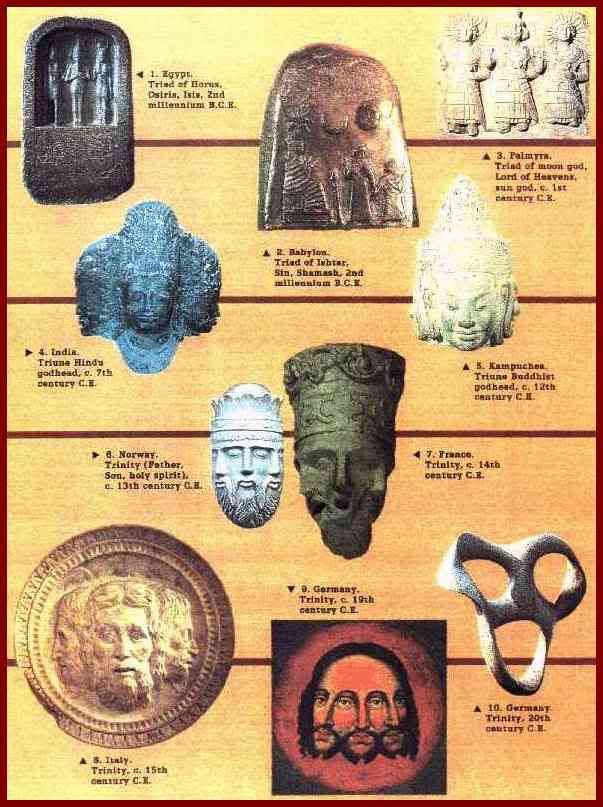
Trinity, The Pagan Origin

Trinity, The Pagan Origin

The "Dictionary of Religious Knowledge":
"Many say that the Trinity is a corruption borrowed from the heathen religions, and ingrafted on the Christian faith."

Edward Gibbon says in the preface to the "History of Christianity":
"If Paganism was conquered by Christianity, it is equally true that Christianity was corrupted by Paganism. The pure deism of the first Christians[belief in only ONE God]...was changed, by the Church of Rome, into the incomprehensible dogma of the Trinity. Many of the pagan tenets, invented by the Egyptians and idealized by Plato, were retained as being worthy of belief."
Egyptian Trinity [Horus, Isis, and Osiris]

"Origin of Triads and Trinities", Mr.Newton quotes Professor Sayce (Gifford Lectures and Hibbert Lectures):
"The indebtedness of Christian theological theory to ancient Egyptian dogma is nowhere more striking than in the doctrine of the Trinity. The very same terms used of it by Christian theologians meet us again in the inscriptions and papyri of Egypt."

The Nouveau Dictionary Universel:
"The Platonic Trinity, itself merely a rearrangement of older trinities dating back to earlier peoples,appears to be the rational philosophic trinity of attributes that gave rise to the three hypostases or divine persons taught by the Christian churches…This Greek philosopher’s [Plato, fourth century BCE]conception of the divine trinity…can be found in all the ancient [pagan] religions" (Paris, 1865-1870,edited by M. Lachatre, Vol. 2, p. 1467).


The New Schaff-Herzog Encyclopedia of Religious Knowledge:
"The doctrines of the Logos and the Trinity received their shape from Greek Fathers, who were much influenced, directly or indirectly, by the Platonic philosophy. That errors and corruptions crept into the church from this source cannot be denied."

The Church of the First Few Centuries":
"The Doctrine of the Trinity was of gradual and comparatively late formation. It had its origin in a source entirely foreign from that of the Jewish and Christian Scriptures. It grew up, and was ingrafted on Christianity, through the hands of the Platonizing Fathers."

Outlines of the History of Dogma:
"Church doctrine became rooted in the soil of Hellenism [pagan Greek thought]. Thereby it became a mystery to the great majority of Christians."

Plato(Father of Pagan Trinity):
"God can in no way be described." -- Plato (Father of the pagan Trinity)

Dr.Walter Martin:
"The Trinity itself is a mystery or a "holy secret". It is incomprehensible. It can never be fully understood."

Trinity, The Innovated Doctrine

Trinity, The Innovated Doctrine

The New Encyclopædia Britannica:
"Neither the word Trinity, nor the explicit doctrine as such, appears in the New Testament, nor did Jesus and his followers intend to contradict the Shema in the Old Testament: 'Hear, O Israel: The Lord our God is one Lord' (Deut. 6:4). . . . The doctrine developed gradually over several centuries and through many  controversies. . . . By the end of the 4th century . . . the doctrine of the Trinity took substantially the form it has maintained ever since."-(1976), Micropædia, Vol. X, p. 126.

The Catholic Encyclopedia:
"In Scripture there is as yet no single term by which the Three Divine Persons are denoted together. The word [tri'as] (of which the Latin trinitas is a translation) is first found in Theophilus of Antioch about A. D. 180. . . . Shortly afterwards it appears in its Latin form of trinitas in Tertullian."

The New Catholic Encyclopedia:
"The formulation 'one God in three Persons' was not solidly established, certainly not fully assimilated into Christian life and its profession of faith, prior to the end of the 4th century. But it is precisely this formulation that has first claim to the title the Trinitarian dogma.
Among the Apostolic Fathers, there had been nothing even remotely approaching such a mentality or perspective
."-(1967), Vol. XIV, p. 299.

The Encyclopedia Americana:
"Christianity derived from Judaism and Judaism was strictly Unitarian [believing that God is one person]. The road which led from Jerusalem to Nicea was scarcely a straight one. Fourth century Trinitarianism did not reflect accurately early Christian teaching regarding the nature of God; it was, on the contrary, a deviation from this teaching."-(1956), Vol. XXVII, p. 294L.

Nouveau Dictionnaire Universel:
"The Platonic trinity, itself merely a rearrangement of older trinities dating back to earlier peoples, appears to be the rational philosophic trinity of attributes that gave birth to the three hypostases or divine persons taught by the Christian churches. . . . This Greek philosopher's [Plato, fourth century B.C.E.] conception of the divine trinity . . . can be found in all the ancient [pagan] religions."-(Paris, 1865-1870), edited by M. Lachâtre, Vol. 2, p. 1467.

John L. McKenzie, S.J., Dictionary of the Bible:
"The trinity of persons within the unity of nature is defined in terms of 'person' and 'nature' which are G[ree]k philosophical terms; actually the terms do not appear in the Bible. The trinitarian definitions arose as the result of long controversies in which these terms and others such as 'essence' and 'substance' were erroneously applied to God by some theologians."-(New York, 1965), p. 899.

The Oxford Companion to the Bible (Metzger and Coogan), pages 782-3:
"Because the Trinity is such an important part of later Christian doctrine, it is striking that the term does not appear in the New Testament. Likewise, the developed concept of three coequal partnersin the Godhead found in later creedal formulations cannot be clearly detected within the confines of the [Bible] canon. ... It is important to avoid reading the Trinity into places where it does not appear."

The New International Dictionary of New Testament Theology (Colin Brown, editor), Volume 2, page 84:
"The Trinity. The NT does not contain the developed doctrine of the Trinity. 'The Bible lacks the express declaration that the Father, the Son, and the Holy Spirit are of equal essence and therefore in an equal sense God himself.. And the other express declarations is also lacking, that God is God thus and only thus, i.e., as The Father, the Son, and the Holy Spirit. These two express declarations, which go beyond the witness of the Bible, are the twofold content of lthe Church doctrine of the Trinity.' (Karl Barth, CD, I, 1, 437). It also lacks such terms as trinity (Lat. trinitas which was coined by Tertullian, Against Praxeas, 3; 11; 12 etc.) and homoousias which feature in the Creed of Nicea (325) to denote Christ was the same substance as the Father."

The Illustrated Bible Dictionary:
"The word Trinity is not found in the Bible . . . It did not find a place formally in the theology of the church till the 4th century."

The Encyclopedia of Religion:
"Theologians today are in agreement that the Hebrew Bible does not contain a doctrine of the Trinity." And the New Catholic Encyclopedia also says: "The doctrine of the Holy Trinity is not taught in the O[ld] T[estament]."

The Triune God, Jesuit Edmund Fortman:
"The Old Testament . . . tells us nothing explicitly or by necessary implication of a Triune God who is Father, Son and Holy Spirit. . . . There is no evidence that any sacred writer even suspected the existence of a [Trinity] within the Godhead. . . . Even to see in [the "Old Testament"] suggestions or foreshadowings or 'veiled signs' of the trinity of persons, is to go beyond the words and intent of the sacred writers."

The Encyclopedia of Religion:
"Theologians agree that the New Testament also does not contain an explicit doctrine of the Trinity."

Jesuit Fortman:
"The New Testament writers . . . give us no formal or formulated doctrine of the Trinity, no explicit teaching that in one God there are three co-equal divine persons. . . . Nowhere do we find any trinitarian doctrine of three distinct subjects of divine life and activity in the same Godhead."

The New Encyclopædia Britannica:
"Neither the word Trinity nor the explicit doctrine appears in the New Testament."

Bernhard Lohse, A Short History of Christian Doctrine:
"As far as the New Testament is concerned, one does not find in it an actual doctrine of the Trinity."

The New International Dictionary of New Testament Theology:
"The N[ew] T[estament] does not contain the developed doctrine of the Trinity. 'The Bible lacks the express declaration that the Father, the Son, and the Holy Spirit are of equal essence' [said Protestant theologian Karl Barth]."

Yale University professor E. Washburn Hopkins:
"To Jesus and Paul the doctrine of the trinity was apparently unknown; . . . they say nothing about it."-Origin and Evolution of Religion.

Historian Arthur Weigall:
"Jesus Christ never mentioned such a phenomenon, and nowhere in the New Testament does the word 'Trinity' appear. The idea was only adopted by the Church three hundred years after the death of our Lord."-The Paganism in Our Christianity.

"Primitive Christianity did not have an explicit doctrine of the Trinity such as was subsequently elaborated in the creeds."-The New International Dictionary of New Testament Theology.

"The early Christians, however, did not at first think of applying the [Trinity] idea to their own faith. They paid their devotions to God the Father and to Jesus Christ, the Son of God, and they recognised the . . . Holy Spirit; but there was no thought of these three being an actual Trinity, co-equal and united in One."-The Paganism in Our Christianity.

Encyclopedia of Religion and Ethics:
"At first the Christian faith was not Trinitarian . . . It was not so in the apostolic and sub-apostolic ages, as reflected in the N[ew] T[estament] and other early Christian writings."-Encyclopædia of Religion and Ethics.

The Formation of Christian Dogma (An Hisjtorical Study of its Problems), by Martin Werner, professor ordinarious in the University of Bern:
"The significance of the Angel-Christology for the Post-Apostolic period, from the point of view of doctrinal history, lies in the fact that it stood in the way of lthe developement of a homoousian doctrine of the Trinity in the later rthodox Nicene sense, owing to its fundamentally Subordinationist character. Angel-Christiology and the Trinitarian dogma of Nicaea were in this respect absolutely incompatiable. (137) Arianism [editor: unitarianism] was doomed. It had indeed, with its reference to Scriptures and the old tradition of the Church, good arguments as its disposal. ... Modalism had criticised the accepted Trinitarian doctrin of the Churchas a doctrine of three gods. (160)
"Every significant theologian of the Church in the pre-Nicene period, had actually represented aSubordinationist Christology. (234)
"Consequently one now began to talk of a divine 'Trinity'. In the Nicene confession-formula of A.D. 325 this concept had been, significantly, lacking. 'Tinitas' = Trias did not signify a kind of 'unity of three', but simply 'threeness.' (252)
"By means of the union of the Logos with a complete human being, the three Persons of the Trinity were increased by a fourth, a human Person. From being a Trias it became a Tetras. ... It was seen from Phil. ii, 6 ff. that the Apostle Pul in no way taught in terms of a scheme which differentiated the Two Natures." (266)
"The course of the age-long dctrinal conflicts of the Early Church shows, for example, that the Trinitarian and Christological problems were by no means effectively settled by the doctrinal decrees of Nicea (325) and Chalcedon
(451)."

Tom Harpur , "For Christ's Sake":
"What is most embarrassing for the church is the difficulty of proving any of these statements of dogma from the new Testament documents. You simply cannot find the doctrine of the Trinity set out anywhere in the Bible. St. Paul has the highest view of Jesus' role and person, but nowhere does he call him God. Nor does Jesus himself anywhere explicitly claim to be the second person in the Trinity, wholly equal to his heavenly Father. As a pious Jew, he would have been shocked and offended by such an Idea....(this is) in itself bad enough. But there is worse to come. This research has lead me to believe that the great majority of regular churchgoers are, for all practical purposes, tritheists. That is, they profess to believe in one God, but in reality they worship three.."


When Jesus was on earth, Judaism was the only purely monotheistic religion in the region, having become surrounded by endless waves of "trinities" from the surrounding nations of the Romans, Greeks, Babylonians and Egyptians. So, why did Jesus (pbuh) chose to allow the very first generations after him live and die never having heard of any "trinity,"till the enlightenment came to the creed-writers and neo-platonic philosophers of the fourth century CE?

Monday, February 25, 2013

Re: hadeeth on sex determination & Genetics !

Another issue is a hadeeth related to Gender determination.

The Main Principles:

a- Quran and Sunnah must be understood according to Arabic langauge after gathering all narrations together as one narration may explain another.

b- In case a hadeeth or an Ayah is proven authentic then we find it contradicting a fact or a sensible event that is agreed on, we reconsider our understanding of the text because an authentic text cannot contradict a fact or agreed on truth.

Scientific Facts:

a. The egg is always the carrier of the X chromosome (X).

b. The spermcell of a man is the carrier of X and Y chromosomes. [i.e. It carries man and women chromosome].

c. a. Determining the gender of children depends solely on the chromosome of the spermcell of the man.

d. The combination of the "X" chromosome of the woman with the chromosome "Y" of the man creates a boy(xy). However, if the "X" chromosome of the woman combine with the chromosome "X" of the man creates a girl (xx).

e. "Y" is manly while X is womanly.

The hadeeth

" ماء الرجل أبيض وماء المرأة أصفر . فإذا اجتمعا، فعلا مني الرجل مني المرأة ، أذكرا بإذن الله . وإذا علا مني المرأة مني الرجل ، آنثا بإذن الله
قَالَ الْيَهُودِيُّ لَقَدْ صَدَقْتَ وَإِنَّكَ لَنَبِيٌّ ثُمَّ انْصَرَفَ فَذَهَبَ ‏.‏ فَقَالَ رَسُولُ اللَّهِ صلى الله عليه وسلم ‏"‏ لَقَدْ سَأَلَنِي هَذَا عَنِ الَّذِي سَأَلَنِي عَنْهُ وَمَا لِي عِلْمٌ بِشَىْءٍ مِنْهُ حَتَّى أَتَانِيَ اللَّهُ بِهِ ‏"‏
http://sunnah.com/muslim/4#38

The True Translation:

The water of the man is white and the water of the woman is yellow. When they get together, if the semen of the man become above the semen of the woman, the child is male, by the permession of Allah, and if the semen of the woman becomes above the semen of the woman, the child is a female by the permession of Allah.
The Jew said: What you have said is true; verily you are an Apostle. He then returned and went away. The Messenger of Allah (may peace be upon him) said: He asked me about such and such things of which I have had no knowledge till Allah gave me that.

Study of the Hadeeth:

a. As we know that women has no role in deciding the gender of the child when fertilization takes place and the text appears to state something that seem to contradict this fact, we need to resort to laid down principles in order to guideline our understanding. This principle state that in such case, we reconsider our understanding to the texts. How? I will explain it in the following point.

b. It is important to pay attention to the used words in the hadeeth. The key words we would like to highlight (I will translate the words of the text litterally to explain it further).

Notes:

a- The word above here means "dominant" as this is one of the known meaning of the word "above" and has been used in Quran to mean "dominant and controlled".

b. The first half of the hadeeth referred to the man and woman liquids as "water" while in the second half he became more specific as referred to it as "semen".

c. We already know that the Prophet صلى الله عليه وسلم mentioned in other hadeeths that the "water" of women is involved in process of fertilization. Then we realized that this water has a description that does not befit ejaculated fuilds since ejaculated fluids are white in color whereas he described the color as yellow and thin.

d. The sound understanding of this text is that the Prophet صلى الله عليه وسلم was referring in this hadeeth to the male and female chromosome of the spermcell of the man (X as the female chromosome and Y as the male chromosome). Based on this, the Prophet meant that when the male factor is dominant then it is a boy but when the female factor is domionant then it is a girl. This is what science states and this is the sound understanding that one should have beacuse the text can be understood in various ways and we know that authentic texts must be in agreement with agreed on facts.

e- He didn't know about that except what Allah told him.

what may be the cause of misunderstanding is that it is because when people "understood" it, they assumed that the word "semen " used in this hadeeth refer to man and woman' water mentioned earlier while as a matter of fact, he صلى الله عليه وسلم was referring to the semen of the man only which is always a carrier of male and female chromosomes. This is supported by the fact that the word "semen" is always exclusively for men while women liquid is always called water only.

In short, it seems according to the words and structure of what was stated, that the issue of "dominance" is purely in targeting the dominance of x chromosome (female) and y chromosomes (male), particularly because women are scientifically not classified as having "sperm"

And Allah knows the best !

Re: Genetics & Hadeeth on resemblance !

Essential introduction:

1. The BASE rule is that an established scientific fact can never contradict an authentic hadeeth or the Qur'an AND vice versa.

2. The realm of contradiction lies in one of the sources as NOT being established, either the scientific theory that is promoted as fact (when in reality it is a theory under a theoretical [phase) or the hadeeth is weak or is not to be understood in the tangent it was mistakenly understood.

3. Conclusively- if there seems to be a contradiction, then most likely the scientific theory that is viewed as a fact in reality is not a fact, or the hadeeth has a flaw in it in terms of its chain back to the prophet, or its understanding was not reached accurately by those who accepted the hadeeth and it is estbalished as correctly attributed to the prophet (alaihi salatu salaam).

4- The Prophet (pbuh)doesn't speak from his own inclination. وَمَا يَنطِقُ عَنِ الْهَوَىٰ
http://quran.com/53/3

Hadeeths touched the topic under discussion:
1- وَإِذَا سَبَقَ مَاءُ الرَّجُلِ مَاءَ الْمَرْأَةِ نَزَعَ الْوَلَدَ، وَإِذَا سَبَقَ مَاءُ الْمَرْأَةِ نَزَعَتْ
http://sunnah.com/urn/41620

2- وَأَمَّا الشَّبَهُ فِي الْوَلَدِ فَإِنَّ الرَّجُلَ إِذَا غَشِيَ الْمَرْأَةَ فَسَبَقَهَا مَاؤُهُ كَانَ الشَّبَهُ لَهُ، وَإِذَا سَبَقَ مَاؤُهَا كَانَ الشَّبَهُ لَهَا ‏"
http://sunnah.com/urn/31100

3- وَهَلْ يَكُونُ الشَّبَهُ إِلاَّ مِنْ قِبَلِ ذَلِكِ إِذَا عَلاَ مَاؤُهَا مَاءَ الرَّجُلِ أَشْبَهَ الْوَلَدُ أَخْوَالَهُ وَإِذَا عَلاَ مَاءُ الرَّجُلِ مَاءَهَا أَشْبَهَ أَعْمَامَهُ ‏
http://sunnah.com/muslim/4#37

In the first 2 hadeeths the word is "Sabaqa" سبق which means
1- precede -outrun.
2- win - defeat - overpower.

In the third hadeeth the word is "alaa" علا which means:
overpower/take over/be superior.
e.g:
http://corpus.quran.com/wordmorpholo...%2823:91:17%29
Translation:

The Prophet صلى الله عليه وسلم said: Let her ask, for i resemblance happens because of it. when her water/discharge is dominant, the born child resembles his maternal uncles but if water/discharge of the man was dominant, the born child should resemble his paternal uncles."

The content of this narration is reported in other narrations as well and despite the slight difference of words, all narrations include the highlighted words.

They key words of this hadeeth are:

a- water [i.e. liquid] of women
b-water of men(semen)
c- dominance
d- resemblance

The topic of this hadeeth is about resemblance.

This narration goes along with the genetic science that resemblance of children is explained through the theory of dominance where only superior genes appear on the child. [This can be one of the interpretations and understanding...]

Water/discharge of women !
One major point that may cause all this confusion about this hadeeth and hence some people find it problemtic is because they tend to immeditaly understand the word "water of women" to mean ejaculated fluid that happens due to intimicay or arousing.

If we pay attention to the words used in this hadeeth we will find outstanding findings i.e. He صلى الله عليه وسلم used the word "water" in reference to the liquid of women and he did not specify it any further.

Well, there is no one better to explain one narration except the one who said it.

For this reason, let's know first what the Prophet صلى الله عليه وسلم meant with "water of women" since he did not specify it. Well, true that he did not specify it but he actually described it when he said in another narration " the water" of women is yellow and thin. So, what is that fluid that has such description?Simple, it is known that ejaculated discharges due to arousing or intimiacy are white.

The only liquid that is yellow is actually called "Follicuar Fluid" that is discharged at ovulation without being related to copulation or being aroused and it is directly related to preganacy. It comes out with a thin layer called follicle of which inside there is a small egg that supposed to combine with the men sperm during fertilization in order for a child to be created.

Finally, I would like you to understand that these narrations came in response to questions about why? and not to answer a question of how? In other words neither the questioner nor answerer [i.e. the Prophet] intended to explain the howness of this process. Rather, he wanted to explain why children sometimes resemble their fathers and some other times resemble their mothers.
This is proven and well explained in the other hadeeth when the Prophet clearly state that resemblence is a pure genetic when a woman delivered a black boy and the man doubted that his wife may have slept with another man as none of the family was black. When he explained it to the man he told him that a genetics of great grandfather may effect grand children. From this you know that it is obvious that the Prophet (صلى الله عليه وسلم) acknowledged that determining the howness was left for us to discover but the hadeeth only provided us with the key, which is the answer to why this happen.

Allah knows the best !