Showing posts with label bible. Show all posts
Showing posts with label bible. Show all posts
Sunday, January 19, 2020

Saturday, July 6, 2019
Thursday, February 21, 2019
Date of the Fourth Gospel !
The Date of the Gospel of John in the Scholarly Literature
Needless to say, the pre-70
CE theory is not widely accepted by both Christian and secular
scholars. Most scholars date it to the late 1st century CE, while some even date it to “around the turn of the second century”.[2] Gary M. Burge states that:Similarly, Lamar Williamson suggests a date “near the end of the first century C.E.”[4] This was echoed by the late D. Moody Smith Jr. in his commentary on the Gospel of John, while also considering the early second century as well. According to Smith (emphasis in the original):“…we find a remarkable consensus of scholarly opinion that John was published somewhere between 80 and 100.”[3]
Another Christian scholar, the late Raymond Brown, believed the “final form” of the gospel was finished between 100-110 CE (and no later than 125), while the “main composition” was written around 90 CE.[6]“[g]iven 110 as the latest possible date (terminus ante quem), we would then have a range of a couple of decades (90-110), within which John was likely written…”[5]
Indeed, most of the dates suggested by different scholars fall somewhere between the years 80-100, with different preferred ranges. According to David Croteau (Liberty University), these include 80-85 (Carson, Köstenberger and others), 80-90 (Godet), 80-100 (Hendriksen), and 90-100 (Brown, Witherington and many others).[7] For his own part, Croteau favors a date between 80-100 but “with the most likely time being toward the earlier side of that range”.[8] Here is a graphical representation of the different dates given, according to Croteau’s list,[9] which shows the general consensus for a date sometime around the end of the first century (most favor a date between 90-100). This also shows how difficult it is for scholars to come to any agreement on what the date actually was:
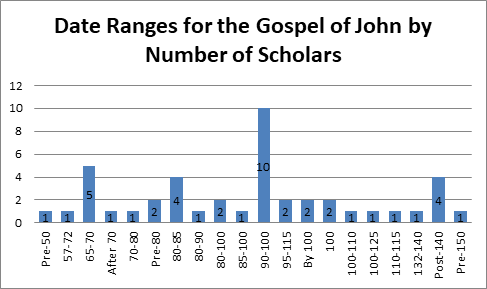
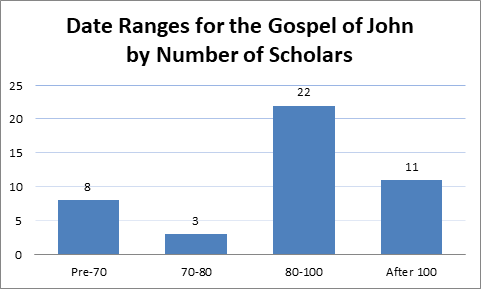
So it is clear that most scholars have preferred a date towards the end of the first century, and some prefer a date even into the early second century.[10] In fact, more scholars favor a date after 100 CE than scholars who favor a pre-70 CE date. So where does that leave the theory of the gospel being written before 70 CE? One of the most vocal supporters of this theory is the contemporary NT scholar Daniel Wallace, who primarily rests his argument on the basis of one particular verse, John 5:2 (although it is certainly not the only reason).[11]
John 5:2 as Proof for a Pre-70 CE Date and Analysis
John 5:2 states:Wallace is particularly interested in the phrase “there is”, which in Greek is ἐστί (e-stē’).[12] He argues that the author wrote in the present tense, which implies that the “Sheep Gate” of the temple (and thus the temple itself) was still standing in his day. This matters because both the gate and the pool at Bethesda were supposed to have been destroyed by the Romans in 70 CE, along with the temple. Thus, the argument goes, the gospel must have been written before the destruction of the temple and not after.“Now there is in Jerusalem near the Sheep Gate a pool, which in Aramaic is called Bethesda[a] and which is surrounded by five covered colonnades.” (NIV)
While this argument may be plausible, there are still a few problems that cannot be explained. First of all, just because the pool was in Jerusalem does not mean that it was destroyed along with the temple and its surrounding landmarks, or that it was destroyed and never rebuilt. It is also possible that the author of the gospel could have simply been referring to the ruins of the pool. Andreas Köstenberger, a Christian scholar, argues against using John 5:2 for dating the gospel to pre-70 CE on this basis. He states that:
This is also suggested by the text of the gospel itself, at least according to the New International Version translation. Verse 3 is rendered as stating that people suffering from all manner of disabilities and illnesses “used to lie” in the pool, which implies that this was no longer the case in the author’s time:“…the reference could be to remains of the structure or the structure could have been rebuilt after being destroyed but prior to John’s writing…”[13]
Admittedly, other translations render the verse differently, which would not imply the past tense. For example, the English Standard Version (ESV) renders the verse as:“Now there is in Jerusalem near the Sheep Gate a pool, which in Aramaic is called Bethesda[a] and which is surrounded by five covered colonnades. Here a great number of disabled people used to lie—the blind, the lame, the paralyzed.”[14]
So we need to dig deeper. As Köstenberger suggested, what if the author was really referring to the ruins of the pool, something people in his time would have been familiar with? The ruins of the pool were well-known even to later Christians. According to Titus Kennedy:“In these lay a multitude of invalids–blind, lame, and paralyzed.”
So if the ruins were known for centuries after Jesus (peace be upon him), it seems plausible that the gospel was referring to those ruins as well. In fact, it was well known to later Christians up until the 7th century (during the Arab conquest), when the precise location of the pool was lost, only to be rediscovered by archaeologists in the 19th century.“Eusebius, writing in the fourth century, mentions the “sheep pool” not the sheep gate, and he identified it as a place of twin pools (Eusebius, Onomasticon). The Bordeaux Pilgrim in the early fourth century calls them twin pools but mentions no gate, while other writings of the fourth and fifth centuries also mention the site of the pool, demonstrating that the ruins of the pool were visited during the Late Roman and Byzantine periods (Itinerarium Burdigalense; Cyril of Jerusalem; Jerome).”[15]
Moreover, some alternate versions of the text do indeed show that the author was writing in the past tense in the important second verse. According to Benson’s Commentary (emphasis in the original):
If this reading was correct,[17] then it follows that the author was indeed referring to the ruins of the pool, since he was implying that the pool was no longer used for such purposes, which could only have happened after the destruction of Jerusalem by the Romans.“[t]he Syriac seems to have read, ην, there was, as it is rendered in that version in the past time. Cyril, Chrysostom, and Theophylact favour this reading, as also does Nonnus.”[16]
The other problem is that the text of John 5:2 doesn’t even mention the word “gate”. The Greek text has been described as “rather obscure”,[18] which has resulted in most translations simply assuming that the author spoke of the “Sheep Gate”, even though other translations are also possible (such as “Sheep market”). As the United States Conference of Catholic Bishops (USCCB) admits:
According to D. Moody Smith, the obscurity may have been due to the simple matter of the author’s own uncertainty. He explained that:“[t]here is no noun with Sheep. “Gate” is supplied on the grounds that there must have been a gate in the NE wall of the temple area where animals for sacrifice were brought in…”[19]
This may also explain the use of the phrase “there is in/at Jerusalem” in John 5:2. It could merely have been a direct quote of the earlier source (see note #20) that the author was using and therefore not evidence that the entire gospel as it has reached us was actually written before the destruction of the temple in 70 CE. Indeed, if the author was an eyewitness and new the landmarks of Jerusalem quite well, why is the description so vague?“…the roughness and difficulties arise from the fact that the narrative is here based on a more ancient tradition; perhaps the author himself was not fully conversant with the material he was using.”[20]
Despite these issues, it is still worthwhile to study the Greek phrase that has created so many disagreements between scholars. As previously stated, Daniel Wallace is supportive of the idea that the verse seems to be in the present tense, which indicates that the author was writing at a time when the temple and its various “gates” were still standing (i.e. before 70 CE). But most other scholars are not convinced. The reason is of course that there are other factors to consider when trying to date the gospel itself. On the basis of these other factors, most scholars are simply not persuaded by one verse to date the entire gospel.
The Greek ἐστί ἐν (“there is in/at”) is in the present tense.[21] But most scholars regard it as a “historical present tense”. Jason Kerrigan quotes none other than Daniel Wallace himself (emphasis in the original) to explain that:
So even though the Greek phrase is in the present tense, it does not necessarily mean that the author was literally writing in the present tense as if the temple and the pool at Bethesda were still standing in his time. Köstenberger has argued that John 10:8 and 19:40 serve as examples, similar to 5:2, of historical presents of εἰμί (“to be” or “to exist”).[23] Nevertheless, Thayer’s Greek Lexicon includes John 5:2 among other verses where εἰμί is translated as “to be found” or “there was” though it still defines the etymology of εἰμί as:“[t]he historical present is used fairly frequently in narrative literature to describe a past event…The reason for the use of the historical present is usually to portray an event vividly, as though the reader were in the midst of the scene as it unfolds. […] The historic present may be used to describe a past event, either for the sake of vividness or to highlight some aspect of the narrative.”[22]
But Wallace has objected to the association of John 5:2, 10:8 and 19:40 as examples of historical presents of εἰμί.[25] Nevertheless, Köstenberger maintains that “it is certainly possible” to use “a past-referring use of the present tense of [εἰμί]”.[26] Croteau also identifies John 5:2 as “probable for inclusion” among a list of historical presents in the Gospel of John.[27] He also includes John 19:40 in this list, but not John 10:8. Mavis Leung also identifies John 5:2 as a historical present, though he acknowledges that it does not “fit neatly” into the “three main verbal categories: speaking, seeing and moving”.[28] However, he does identify it as one of three “past-referring indicative verbs”, the others being found in John 20:6 and 21:22.[29] Of course, it should be borne in mind that there is considerable debate about what constitutes a historical present, as we can already clearly see. Leung counts 165 examples in the Gospel of John, whereas other counts have varied from 162 to 166.[30] For his part, Wallace counts 162 examples, not including 5:2 of course.[31] So it does not seem like there will be a breakthrough regarding the date of the fourth gospel on the basis of this verse alone. Thus, perhaps more attention should be paid to other pieces of evidence when trying to date the fourth gospel.“[t]he first person singular present indicative…”[24]
Much such “evidence” has been presented from both liberal and conservative scholars, with many Christians obviously trying to prove the earliest possible date. But David Croteau, much to his credit since he is a Christian himself, shows more caution. He rejects most of the arguments for a pre-70 date, and favors a date between 80-100.[32] Though he lists several arguments for a post-70 date, there are a few which appear stronger than others. These are listed here:
- Church fathers
- John 6:1 and the “Sea of Tiberias”
If the Gospel of John was written earlier (perhaps around the same time as the Synoptic gospels) or even a little later, we would not expect it to refer to the “Sea of Tiberias” instead of the “Sea of Galilee”. It would be like if someone allegedly wrote a book about East Pakistan in 1947 (when Pakistan was founded) but referred to it as “Bangladesh”, which was the name it adopted in 1971 only after breaking away from West Pakistan. One would have to conclude that the document was written much later than it was claimed. The same conclusion would arise for the date of the fourth gospel (assuming if it was not redacted later) due to its reference to the Sea of “Tiberias” instead of the “Sea of Galilee”.
- John 20:28 and Domitian as Dominus et Deus
Of course, there was nothing unusual in Domitian demanding that he be worshiped. Previous emperors were also objects of worship. As Professor Paul Trebilco states:“…likely accounts for why the Evangelist chose to include Thomas’s words…”[45]
But by specifically demanding that he be referred to as “Lord and God” in written or verbal correspondence, Domitian was unique among the emperors. Thus, it is possible that the author of the fourth gospel used Thomas’ reaction to the resurrected Jesus as a direct act of defiance against Domitian’s decree specifically or against the Roman imperial cult in general.[47]“…there is no evidence that Domitian demanded greater divine honours than his predecessors…”[46]
Conclusion
Given these strong and
compelling arguments, it seems prudent to stick with the current
near-consensus regarding the date of the Gospel of John. A date near
the end of the 1st century indeed seems most likely. We have
seen that John 5:2 has other explanations, even if it was not meant to
be in the historical present tense. Moreover, other pieces of evidence
strongly outweigh John 5:2 as far as determining the date.
Addendum: A Brief Discussion of Authorship
It was not the purpose of
this article to discuss the issue of authorship, but it is an important
issue. Here, we will provide a brief overview.Church tradition maintains that the fourth gospel was written in Ephesus near the end of the 1st-century (a view which seems to align with the internal evidence, at least with regard to the time period),[48] but equally importantly, it maintains that the author was an eyewitness and disciple of Jesus (peace be upon him), whose name was John (the son of Zebedee). But whereas the evidence for the date of composition seems to support church tradition, the evidence for authorship is flimsy at best. In his commentary on the Gospel of John, the late D. Moody Smith explained that there are “as many reasons for doubting Johannine authorship as for embracing it”.[49]
First and foremost is the fact that the gospel does not state who the author is. It is anonymous (more on this later). Second, it is possible that the author was simply another “John” who later became confused with John the disciple. It was claimed by Eusebius that Papias had claimed that the author was a certain “John the Elder”, who had known Jesus and heard him teach.[50] Yet even this theory clearly suffers from the same problem as claiming that the author was John the son Zebedee. It is all hearsay. Smith refers to it as “at best a reasonable conjecture based on bits and pieces of evidence”.[51]
Another difficulty in assigning authorship to John is the claim that he wrote the gospel while residing in Ephesus. Here, church tradition seems to have muddied the water. While Irenaeus claimed the gospel was written in Ephesus, an earlier source, Ignatius of Antioch, did not mention that John resided at Ephesus at any time. Smith observed that Ignatius “makes a great deal of the apostle Paul’s residence there, but, strangely, does not mention John”.[52] To make matters worse, neither the New Testament nor any early 2nd-century Christian document puts John in Ephesus.[53]
Finally, in an interesting analysis of chapter 20, Smith argued that the author intentionally remained anonymous. Smith also surmised that if any of the disciples of Jesus qualified as the “beloved disciple”, it would have been Thomas, not John.[54] Since chapter 21 seems to be a later addition,[55] and since Thomas is the last disciple mentioned at the end of chapter 20, it follows then he should qualify as the “beloved disciple”, at least in the “original” ending of the gospel. Even if chapter 21 was the original ending, Smith, quoting David R. Beck (who believed 21:24-25 was the end of the gospel), notes that there is simply no specific disciple who is identified as the “beloved disciple”, so that “he remains anonymous, as the evangelist intended”.[56] But if the author really was John the son of Zebedee or any other disciple, why did he go out of his way to remain anonymous? If anything, it would bolster the credibility and authority of the gospel to directly name a specific disciple, but instead, the author deliberately decided to be anonymous. It does not make much sense. Therefore, in the absence of any conclusive evidence, the theory of Johannine authorship of the fourth gospel stands on thin ice. Most likely, it was just a misattribution, as with the Synoptics.
And Allah (Glorified and Exalted be He) knows best!
Source
Saturday, June 17, 2017
Is this the word of God ?
In the bible, a book that supposed to be inspired by God, we read:
2 Maccabees 1
1 From the Jews of Jerusalem and Judea to those in Egypt, warm greetings.2 May God be good to you and keep the covenant he made with Abraham, Isaac, and Jacob, his faithful servants.
2 Maccabees 15
38 And if I have done well, and as is fitting the story, it is that which I desired: but if slenderly and meanly, it is that which I could attain unto.39 For as it is hurtful to drink wine or water alone; and as wine mingled with water is pleasant, and delighteth the taste: even so speech finely framed delighteth the ears of them that read the story. And here shall be an end.
2 Maccabees2
The topic was 5 books, however the person has "summarized" it:
23 All these things (I say) being declared by Iason of Cyrene in five books, we will assay to abridge in one volume.24 For considering the infinite number, and the difficulty, which they find that desire to look into the narrations of the story, for the variety of the matter,25 we have aimed to please those who wish to read, to make it easy for those who are inclined to memorize, and to profit all readers.26 Therefore to us that have taken upon us this painful labour of abridging, it was not easy, but a matter of sweat, and watching.27 Even as it is no ease unto him, that prepareth a banquet, and seeketh the benefit of others: yet for the pleasuring of many we will undertake gladly this great paines:28 Leaving the responsibility for exact details to the historian, and confining our efforts to presenting only a summary outline.29 For as the master builder of a new house, must care for the whole building: but hee that undertaketh to set it out, and paint it, must seek out fit things for the adorning thereof: even so I think it is with us.30 It is the duty of the original historian to occupy the ground and to discuss matters from every side and to take trouble with details,31 but the one who recasts the narrative should be allowed to strive for brevity of expression and to forego exhaustive treatment.32 At this point therefore let us begin our narrative, adding only so much to what has already been said; for it is foolish to lengthen the preface while cutting short the history itself.
Quran 2:97:
فَوَيْلٌ لِّلَّذِينَ يَكْتُبُونَ
الْكِتَابَ بِأَيْدِيهِمْ ثُمَّ يَقُولُونَ هَٰذَا مِنْ عِندِ اللَّهِ
لِيَشْتَرُوا بِهِ ثَمَنًا قَلِيلًا ۖ فَوَيْلٌ لَّهُم مِّمَّا كَتَبَتْ
أَيْدِيهِمْ وَوَيْلٌ لَّهُم مِّمَّا يَكْسِبُونَ
So woe to those who write the "scripture" with their own hands, then say, "This is from Allah ," in order to exchange it for a small price. Woe to them for what their hands have written and woe to them for what they earn.
Friday, April 21, 2017
Fake story: John 8:7 "Let anyone among you who is without sin be the first to throw a stone " forgery; Woman caught in adultery in earliest manuscripts !
There is general agreement that the verses from John 7:53 to John 8:11 were not written by the author or authors who wrote the rest of the gospel. There is little consensus as to exactly when the forgery was inserted.
Chris Keith is professor of New Testament and Early Christianity at St Mary's University where he also serves as Director of the Centre for the Social-Scientific Study of the Bible.
The story of the woman caught in adultery, typically located at John 8:1-8:11, is one of the most popular stories in the entire Bible. Jesus’ lack of condemnation of a known sinner captivates some readers, as does his statement “Let anyone among you who is without sin
be the first to throw a stone at her” (John 8:7) and the manner in which he outwits the scribes and the Pharisees with that statement. Since, as his opponents note (John 8:5), the law of Moses demanded that an adulteress be killed, Jesus’ opponents have thrust him upon the horns of a dilemma. He has to choose either to allow
the woman to go free and publicly disobey the law of Moses or to approve of her killing and forfeit his reputation as a friend to sinners (and possibly risk trouble with Rome for contributing to a capital punishment that they
had not sanctioned). The cleverness of Jesus’ response in John 8:7 is that it renders the enactment of the legal punishment impossible without requiring his public disavowal of the law.
Interestingly enough, the earliest manuscripts of the Gospel of John do not contain this beloved passage. Indeed, the first manuscript to contain the story is from around 400 C.E. Around 4% of Greek manuscripts
that include the passage place it in locations other than John 8:1-8:11; the earliest of these is from around the ninth and tenth centuries C.E. This perplexing manuscript history fuels debates about whether
the story was originally in John’s Gospel and, if so, where. The majority of scholars believe a later Christian scribe inserted the passage into John’s Gospel at John 8:1-8:11 and that the alternate locations are due to the effects of later liturgical reading in what is known as the lectionary system. [ Chris Keith, "Manuscript History and John 8:1-8:11", n.p. [cited 21 Apr 2017]. Online: http://www.bibleodyssey.org/en/passages/related-articles/Manuscript History and John].
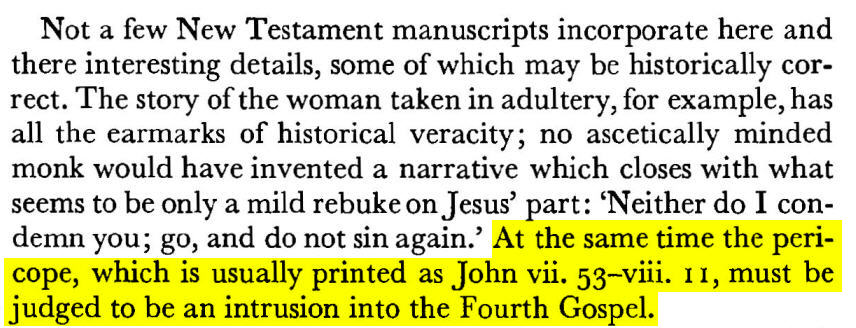
The text of the New Testament : It’s Transmission Corruption
and RestorationSecond Edition By Bruce M. Metzger Page 223

Manuscripts that doesn’t conain the story:
( p66 , p75 , א , B , L , N , T , W , X , Δ , Θ , Ψ , 33 , 157 , 565 , 892 , 1241 )
.
Daniel B. Wallace* on the fake story:
https://www.youtube.com/watch?v=cobVbGs5yXM
(*= Senior Research Professor of New Testament Studies at Dallas Theological Seminary)
Bart Ehrman** on the fake story:
(*= Senior Research Professor of New Testament Studies at Dallas Theological Seminary)
Bart Ehrman** on the fake story:
https://www.youtube.com/watch?v=MhIUkF_FT2I
(**= James A. Gray Distinguished Professor, Department of Religious Studies at the University of North Carolina at Chapel Hill)
(**= James A. Gray Distinguished Professor, Department of Religious Studies at the University of North Carolina at Chapel Hill)
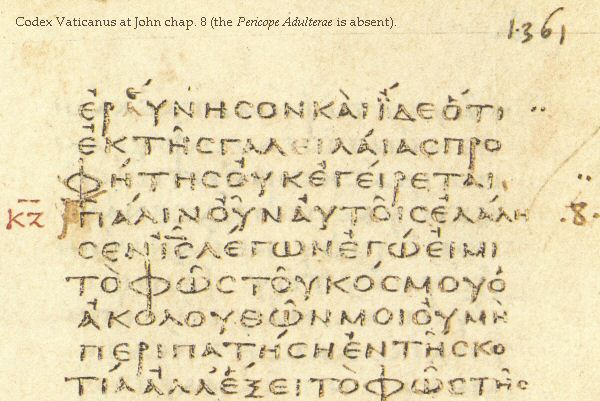
Below is an image of page NB (52) of Papyrus 66, a codex of John's Gospel from about AD 200. The begins in the middle of the word εραυνησον ("search")
in John 7:52. On the second line the sentence ends with a punctuation mark and is immediately followed by Παλιν ουν αυτοις ελαλησεν ο Ις ("again Jesus spoke to them") in 8:12, omitting the Story of the Adulteress.
The manuscript has been annotated by a scribe who used diagonal strokes to indicate a word-order variant in the first and second lines, but the Story of the Adulteress is omitted without any notation.

The manuscript has been annotated by a scribe who used diagonal strokes to indicate a word-order variant in the first and second lines, but the Story of the Adulteress is omitted without any notation.
The New Commentary on the Whole Bible
"This story is not included in the best and earliest manuscripts [of John]. In fact, it is absent from all witnesses earlier than the 9th century, with the exception of a
fifth century Greek-Latin manuscript. No Greek church father comments on the passage prior to the 12th century.Jamieson et al, "The New Commentary on the Whole Bible", Tyndale, Wheaton IL (1990), P. 247-248
The "Interpreter's One Volume Commentary on the Bible"
"7:53-8:11: This passage is omitted or set off in modern editions of the gospel since it does not appear in the oldest and best manuscripts and is apparently a later interpolation. In some manuscripts it occurs after Luke 21:38
The Five Gospels
"The story of the woman caught in the act of adultery...was a 'floating' or 'orphan' story. It is almost certainly not a part of the
original text of John, but is a noteworthy tradition nonetheless...While the Fellows [of the Jesus Seminar] agreed that the words did not originate in their present form with Jesus, they nevertheless assigned the words and
story to a special category of things they wish Jesus had said and done."
Saturday, December 3, 2016
Matthew 19:29: 100 wives for Christians in Heaven !
And
every one that has forsaken houses, or brothers, or sisters, or father,
or mother, or wife (ἤ γυναῖκα), or children, or lands, for my name's sake, shall
receive a hundred times more, and shall inherit everlasting life.
Verse 29. - ....." Some manuscripts, followed by some modern editors, omit or wife,
the omission being probably first made by some critical scribe, who
deemed that a wife should never be left. The Lord enumerates the persons
and objects upon which men's hearts are most commonly and firmly fixed.
He begins and ends the list with material possessions - houses and
lands, and between them introduces in gradation the most cherished
members of the family circle. "Forsaking wife and children" may be
understood as abstaining from marriage in order the better to serve God.
For my Name's sake. In consequence of
belief in Christ, rather than do despite to his grace, or in order to
confess and follow him more completely........ An hundredfold. Some read "manifold," as in Luke 18:30.
The spiritual relationship into which religion would introduce him
largely compensates for the loss of earthly connections. He shall have
brothers and sisters in the faith - hundreds who will show him the
affection of father and mother, hundreds who will love him as well as
wife and children. ..........
The hope of future happiness is in itself sufficient to lighten and
dissipate all earthly troubles, and to stimulate severest sacrifices."
This verse is a proof that the bible is altered according to scribes' own desires.
Thursday, November 24, 2016
Reasons to Believe in the corruption of the Gospels
Asalamualaykum,
In a previous post three reasons to believe in the corruption of the Torah were offered. In this post the same will be done for the four Gospels: Matthew, Mark, Luke and John.
1- Christological Evolution
There’s disagreement surrounding exactly when the four gospels were written, but if we were to be generous with the dates:
Mark, written ~60 CE
Matthew and Luke, written ~75 CE
John, written ~90 CE
For reference, 'Isa (عليه السلام) is believed to have died sometime after the year 30 CE.
If one were to compare earlier gospels with later ones, one will find that there is a general trend of embellishing Jesus’ character over time, from Mark, to Matthew and Luke, to John. I.e. Jesus is evolving with every passing account to become more and more god-like. Three examples will be given:
1.1 “God” or “Father”?
We read in Mark 3:35 that Jesus says:
Whoever does God’s will is my brother and sister and mother.
The same statement is reported in Matthew 12:50, but with an important twist:
For whoever does the will of my Father in heaven is my brother and sister and mother.
The earlier gospel (Mark) has Jesus saying “God” where the later gospel (Matthew) has this changed to Jesus calling God “Father”. Such an embellishment serves to portray Jesus as more than just a human who is subservient to his Lord.
1.2 Peter’s Response
In the gospels of Mark and Matthew, Jesus is reported to have asked his disciples: “Who do you say I am?”
In Mark 8:29 Peter’s response was:
“You are the Messiah.”
In Matthew 16:16 Peter’s response is recorded as:
“You are the Messiah, the Son of the living God.”
Notice how the later gospel (Matthew) adds the phrase “the Son of the living God”, which is lacking from the earlier gospel (Mark). Ask yourselves, which is more likely: Mark simply choosing not to record this very significant phrase? Or Matthew coming along and deliberately adding it onto the text to make a point?
1.3 Judas’ Betrayal
The gospels record the moment when Judas betrays Jesus, and calls for the soldiers to come and arrest him. Let us take the accounts of Mark, Luke and John for comparison:
According to Mark 14:44-46:
Now the betrayer [Judas] had arranged a signal with them [the guards]: “The one I kiss is the man; arrest him and lead him away under guard.” Going at once to Jesus, Judas said, “Rabbi!” and kissed him. The men seized Jesus and arrested him.
According to Luke 22:47-48:
While he [Jesus] was still speaking a crowd came up, and the man who was called Judas, one of the Twelve, was leading them. He approached Jesus to kiss him, but Jesus asked him, “Judas, are you betraying the Son of Man with a kiss?”
According to John 18:3-6:
So Judas came to the garden, guiding a detachment of soldiers and some officials from the chief priests and the Pharisees. They were carrying torches, lanterns and weapons. Jesus, knowing all that was going to happen to him, went out and asked them, “Who is it you want?”
“Jesus of Nazareth,” they replied.
“I am he,” Jesus said. (And Judas the traitor was standing there with them.) When Jesus said, “I am he,” they drew back and fell to the ground.
Again a huge difference between the three accounts, where Jesus is portrayed as more powerful according to the later gospels when compared to the earlier ones.
According to the earliest account found in Mark: The soldiers did not know who Jesus was, so Judas had to single him out for them by kissing Jesus’ hand. Judas approaches Jesus, kisses his hand, and immediately afterwards the guards seize Jesus. That's it for Mark's version of the story.
Then comes the account in Luke. According to Luke, when Jesus sees Judas approaching he immediately realizes that Judas was betraying him. Before Judas could even kiss his hand, Jesus asks him: “are you betraying the Son of Man with a kiss?” A clear embellishment from Mark’s depiction, implying that Jesus is more knowledgeable.
Finally we have the latest account in John. According to John, Judas doesn’t even get to approach Jesus, let alone kiss him. As soon as Jesus sees Judas he immediately knows of his treachery. In fact, John explicitly states that Jesus knew exactly what was going to happen to him. The gospel of John then takes this story one step further- according to John the soldiers don’t arrest Jesus, rather it is implied that he gives himself up to them. Jesus is the one who asks the approaching soldiers “Who is it you want?” and when he proclaims that he is indeed Jesus of Nazareth, they all fall to the ground in awe of his power. According to John, Jesus is completely in control of the entire situation.
In a previous post three reasons to believe in the corruption of the Torah were offered. In this post the same will be done for the four Gospels: Matthew, Mark, Luke and John.
1- Christological Evolution
There’s disagreement surrounding exactly when the four gospels were written, but if we were to be generous with the dates:
Mark, written ~60 CE
Matthew and Luke, written ~75 CE
John, written ~90 CE
For reference, 'Isa (عليه السلام) is believed to have died sometime after the year 30 CE.
If one were to compare earlier gospels with later ones, one will find that there is a general trend of embellishing Jesus’ character over time, from Mark, to Matthew and Luke, to John. I.e. Jesus is evolving with every passing account to become more and more god-like. Three examples will be given:
1.1 “God” or “Father”?
We read in Mark 3:35 that Jesus says:
Whoever does God’s will is my brother and sister and mother.
The same statement is reported in Matthew 12:50, but with an important twist:
For whoever does the will of my Father in heaven is my brother and sister and mother.
The earlier gospel (Mark) has Jesus saying “God” where the later gospel (Matthew) has this changed to Jesus calling God “Father”. Such an embellishment serves to portray Jesus as more than just a human who is subservient to his Lord.
1.2 Peter’s Response
In the gospels of Mark and Matthew, Jesus is reported to have asked his disciples: “Who do you say I am?”
In Mark 8:29 Peter’s response was:
“You are the Messiah.”
In Matthew 16:16 Peter’s response is recorded as:
“You are the Messiah, the Son of the living God.”
Notice how the later gospel (Matthew) adds the phrase “the Son of the living God”, which is lacking from the earlier gospel (Mark). Ask yourselves, which is more likely: Mark simply choosing not to record this very significant phrase? Or Matthew coming along and deliberately adding it onto the text to make a point?
1.3 Judas’ Betrayal
The gospels record the moment when Judas betrays Jesus, and calls for the soldiers to come and arrest him. Let us take the accounts of Mark, Luke and John for comparison:
According to Mark 14:44-46:
Now the betrayer [Judas] had arranged a signal with them [the guards]: “The one I kiss is the man; arrest him and lead him away under guard.” Going at once to Jesus, Judas said, “Rabbi!” and kissed him. The men seized Jesus and arrested him.
According to Luke 22:47-48:
While he [Jesus] was still speaking a crowd came up, and the man who was called Judas, one of the Twelve, was leading them. He approached Jesus to kiss him, but Jesus asked him, “Judas, are you betraying the Son of Man with a kiss?”
According to John 18:3-6:
So Judas came to the garden, guiding a detachment of soldiers and some officials from the chief priests and the Pharisees. They were carrying torches, lanterns and weapons. Jesus, knowing all that was going to happen to him, went out and asked them, “Who is it you want?”
“Jesus of Nazareth,” they replied.
“I am he,” Jesus said. (And Judas the traitor was standing there with them.) When Jesus said, “I am he,” they drew back and fell to the ground.
Again a huge difference between the three accounts, where Jesus is portrayed as more powerful according to the later gospels when compared to the earlier ones.
According to the earliest account found in Mark: The soldiers did not know who Jesus was, so Judas had to single him out for them by kissing Jesus’ hand. Judas approaches Jesus, kisses his hand, and immediately afterwards the guards seize Jesus. That's it for Mark's version of the story.
Then comes the account in Luke. According to Luke, when Jesus sees Judas approaching he immediately realizes that Judas was betraying him. Before Judas could even kiss his hand, Jesus asks him: “are you betraying the Son of Man with a kiss?” A clear embellishment from Mark’s depiction, implying that Jesus is more knowledgeable.
Finally we have the latest account in John. According to John, Judas doesn’t even get to approach Jesus, let alone kiss him. As soon as Jesus sees Judas he immediately knows of his treachery. In fact, John explicitly states that Jesus knew exactly what was going to happen to him. The gospel of John then takes this story one step further- according to John the soldiers don’t arrest Jesus, rather it is implied that he gives himself up to them. Jesus is the one who asks the approaching soldiers “Who is it you want?” and when he proclaims that he is indeed Jesus of Nazareth, they all fall to the ground in awe of his power. According to John, Jesus is completely in control of the entire situation.
1.4 Jesus being called “Lord” by his disciples
In Mark 4:38 we read:
Jesus was in the stern, sleeping on a cushion. The disciples woke him and said to him, “Teacher, don’t you care if we drown?”
The same event is reported in Matthew 8:25, but again with a twist:
The disciples went and woke him, saying, “Lord, save us! We’re going to drown!”
The wording of the earlier gospel of Mark has the disciples calling Jesus “Teacher”. The later gospel of Matthew has the disciples calling Jesus “Lord”.
1.5 God as the “Father in Heaven”
As we move away from the time of Jesus, the number of times God is referred to as “Father” by him increases in each account.
In the earliest gospel, Mark, Jesus refers to God as “Father” only 5 times.
Between Matthew and Luke, Jesus refers to God as “Father” a total of 41 times (14 times in Luke, 27 in Matthew)
In the latest gospel of John, Jesus refers to God as “Father” 117 times- more times than the other three gospels combined.
Implying a theological agenda on the part of the later gospel authors to depict Jesus as the Son of God, the emphasis for this increasing over time. Source for the count.
1.6 Prayer of Gethsemane
Before his arrest, Jesus is reported to have entered the garden of Gethsemane, and prayed to God to save him.
In Mark 14:35-36 we read:
Going a little farther, he fell to the ground and prayed that if possible the hour might pass from him. “Abba, Father,” he said, “everything is possible for you. Take this cup from me. Yet not what I will, but what you will.”
A similar prayer is found in Matthew (26:39) and Luke (22:42).
However, this prayer- which depicts Jesus as weak and helpless before God, and most importantly unwilling to be crucified- is missing from the latest Gospel of John. Again, an embellishment which serves to portray Jesus as more able than he is. Instead what we have in the gospel of John, is Jesus entering the garden and then the episode of his arrest begins immediately after. The only mention of the Garden goes by very quickly:
In John 18:1 we read:
When he had finished praying, Jesus left with his disciples and crossed the Kidron Valley. On the other side there was a garden, and he and his disciples went into it.
1.7 Matthew’s Donkey Mess-up
In the earliest Gospel of Mark, we read of Jesus asking his disciples to bring him a colt (young donkey) so that he could ride into Jerusalem on its back. Mark 11:2 reads:
[Jesus] saying to them [the disciples], “Go to the village ahead of you, and just as you enter it, you will find a colt tied there, which no one has ever ridden. Untie it and bring it here.”
In Matthew however this is changed to TWO donkeys. We read in Matthew 21:2:
[Jesus] saying to them [the disciples], “Go to the village ahead of you, and at once you will find a donkey tied there, with her colt by her. Untie them and bring them to me.”
Later on in verse 7 of the same chapter, Matthew has Jesus riding into Jerusalem on top of both animals:
They [the disciples] brought the donkey and the colt and placed their cloaks on them for Jesus to sit on.
Two donkeys are better than one, right? Well things get even funnier. This is actually a serious attempt at an embellishment on the part of Matthew’s author. Matthew evidently was skimming through the Old Testament, trying to see what in there he can squeeze into his story about Jesus (so that he can then turn around and say: “Aha! See? The Old Testament hundreds of years ago prophesied about Jesus here!”). Matthew comes across a passage from the book of Zechariah (9:9) which reads:
Rejoice greatly, Daughter Zion! Shout, Daughter Jerusalem! See, your king comes to you, righteous and victorious, lowly and riding on a donkey, on a colt, the foal of a donkey.
Matthew (being someone who obviously doesn’t understand the Old Testament very well) thought Zechariah 9:9 depicted the King of Jerusalem riding on a donkey AND a colt. In an attempt to project this image from Zechariah 9:9 onto Jesus, Matthew in his Gospel then has Jesus riding on both an adult donkey and a colt.
Obviously Matthew misunderstood Zechariah 9:9. For example, if I said: “Billy is a good Christian, an honest man” the intended meaning is that there is a single person named Billy, and that this single person is both a good Christian, and an honest man. I do not mean that there are two people, the first being a Christian named Billy, and the second being an honest man. Likewise with Zechariah 9:9. When the author of Zechariah says the King of Jerusalem will be “riding on a donkey, on a colt” he does not mean the King of Jerusalem will be riding on both an adult donkey AND a colt. Rather on a single animal, who is both a donkey and a colt (i.e. a young donkey).
What does Matthew’s terrible mess-up tell us? It tells us that the gospels were written in retrospect of the Old Testament- that the gospel authors did not mind perverting the story of Jesus’ life for theological reasons. In other words, that the authors of the Gospels were more interested in selling the reader Christian theology, than they were in relaying historical events accurately.
1.8 Jesus Stabbed
In the first three Gospels (Mark, Matthew and Luke) Jesus is allegedly put on the cross on a Friday. The following day being the Sabbath, the Jews had to take him down on Friday’s eve. This meant Jesus was put on the cross for only a few hours. This is very strange, because crucifixion is supposed to be a long and agonizing death. The person being crucified is supposed to suffer on the cross for several days before dying from exhaustion/starvation. But Jesus was only up there for a few hours. In fact this was so strange, that even Pontius Pilate (the governor who had sentenced Jesus to death) was surprised at Jesus’ early death. In Mark 15:44 we read:
Pilate was surprised to hear that he [Jesus] was already dead. Summoning the centurion, he asked him if Jesus had already died.
This is very problematic for Christian theology. Jesus had to have died on the cross for the entire religion to make sense, and there can be no doubts about this pivotal event. So what does the author of the last Gospel (John) do? He has a guard stab Jesus with a spear for good measure. And to not leave readers with any doubts about Jesus’ death on the cross, John describes how blood and water flowed out of Jesus’ stabbed body. In John 19:34:
Instead, one of the soldiers pierced Jesus’ side with a spear, bringing a sudden flow of blood and water.
John's gospel is the only one that mentions this stab.
Of course, this is amongst the many other examples one can give to highlight this evolutionary trend, from the earlier gospels to the later ones. The main point is however, if one extrapolates this trend of embellishing Jesus backwards, to even before Mark was complied, you'd probably get a very human Jesus. A Jesus that’s even more human than Mark’s depiction. And a Jesus that fits perfectly with how Islam sees him.
2- The New Testament says there were earlier Gospels
The New Testament reports that Paul had heated debates against ‘false’ apostles who were teaching ‘false’ gospels.
We read in Galatians 1:6-7:
I am astonished that you are so quickly deserting the one who called you to live in the grace of Christ and are turning to a different gospel, which is really no gospel at all. Evidently some people are throwing you into confusion and are trying to pervert the gospel of Christ.
And in 2 Corinthians 11:13:
For such people are false apostles, deceitful workers, masquerading as apostles of Christ
This is significant for obvious reasons. It suggests there were alternative, competing, Christian traditions to the Pauline narrative. Moreover, those alternative traditions were contemporaneous with Paul himself. What’s even more significant, is that Paul’s material predates the four Gospels. This means those ‘false apostles’, preaching the ‘false gospel’ (according to Paul) predate the four canonical Gospels!
So how can the Christian today prove that the Pauline narrative is the theologically correct one amongst the other early traditions that were competing against it? Why does the Christian trust the Pauline narrative at all? What if one of those - now lost - gospels preached by those who Paul called ‘false apostles’ is actually the true gospel of Christ?
Obviously the modern Christian cannot appeal to the four Gospels to support Paul’s narrative. This is because the four Gospels were written after Paul's work (possibly deliberately crafted to conform with his teachings). All the Christian today has to appeal to, is the Old Testament. And this problematic for two reasons:
-A- Because the Old Testament itself is not reliable (as discussed in another post found here).
-B- There is a huge difference between how Jews have traditionally interpreted the Old Testament, and how Christians interpret it.
3- Fabricated Verses
Modern scholarship had already detected (and removed) many fabricated verses from the New Testament.
Those include, but are not limited to:
3.1 The Pericope de Adultera
The story, where Jesus refuses to stone a woman for committing adultery. Where Jesus famously declares: “Let those without sin cast the first stone”… turns out this story is a fabrication.
The story is found in John 8. Most modern English translations of the Bible will now warn you about this fabrication.
3.2 The Ending of Mark
Verses 16:9-20 of the gospel of Mark, are now considered fabrications by most New Testament scholars. Once again, you will find a warning about this in most modern English translations of the Bible.
What this means is that the Gospel of Mark (or what we have left of it) ends at Mark 16:8:
Trembling and bewildered, the women went out and fled from the tomb. They said nothing to anyone, because they were afraid.
So according to Mark, no one is informed of Jesus’ resurrection… he doesn’t appear to his disciples after his alleged death… nothing. The greatest pillar of Christianity, the resurrection, is not supported by the earliest Gospel.
3.3 The verse of the Trinity
Not part of the gospels per se, but significant nonetheless. The only verse in the entire New Testament which explicitly mentions the trinity is a fabrication.
1 John 5:7 used to read:
For there are three that bear record in heaven, the Father, the Word, and the Holy Ghost: and these three are one.
But this verse has now been taken out from the translations that utilize the earliest manuscripts.
The implications are huge. Not only are those fabrications of great theological importance to the Christian, but the fact fabrications even exist also casts doubt on the veracity of the New Testament’s preservation. If one knows fabrications have crept into their scriptures, how can one be certain that nothing else is a fabrication?
Conclusion:
There are many other reasons to doubt in the preservation of the New Testament (anonymous authorship, contradictions between the gospel accounts, the fact none of the authors even claim to have been inspired…etc.) but those were just the three most interesting ones in my opinion.
In Mark 4:38 we read:
Jesus was in the stern, sleeping on a cushion. The disciples woke him and said to him, “Teacher, don’t you care if we drown?”
The same event is reported in Matthew 8:25, but again with a twist:
The disciples went and woke him, saying, “Lord, save us! We’re going to drown!”
The wording of the earlier gospel of Mark has the disciples calling Jesus “Teacher”. The later gospel of Matthew has the disciples calling Jesus “Lord”.
1.5 God as the “Father in Heaven”
As we move away from the time of Jesus, the number of times God is referred to as “Father” by him increases in each account.
In the earliest gospel, Mark, Jesus refers to God as “Father” only 5 times.
Between Matthew and Luke, Jesus refers to God as “Father” a total of 41 times (14 times in Luke, 27 in Matthew)
In the latest gospel of John, Jesus refers to God as “Father” 117 times- more times than the other three gospels combined.
Implying a theological agenda on the part of the later gospel authors to depict Jesus as the Son of God, the emphasis for this increasing over time. Source for the count.
1.6 Prayer of Gethsemane
Before his arrest, Jesus is reported to have entered the garden of Gethsemane, and prayed to God to save him.
In Mark 14:35-36 we read:
Going a little farther, he fell to the ground and prayed that if possible the hour might pass from him. “Abba, Father,” he said, “everything is possible for you. Take this cup from me. Yet not what I will, but what you will.”
A similar prayer is found in Matthew (26:39) and Luke (22:42).
However, this prayer- which depicts Jesus as weak and helpless before God, and most importantly unwilling to be crucified- is missing from the latest Gospel of John. Again, an embellishment which serves to portray Jesus as more able than he is. Instead what we have in the gospel of John, is Jesus entering the garden and then the episode of his arrest begins immediately after. The only mention of the Garden goes by very quickly:
In John 18:1 we read:
When he had finished praying, Jesus left with his disciples and crossed the Kidron Valley. On the other side there was a garden, and he and his disciples went into it.
1.7 Matthew’s Donkey Mess-up
In the earliest Gospel of Mark, we read of Jesus asking his disciples to bring him a colt (young donkey) so that he could ride into Jerusalem on its back. Mark 11:2 reads:
[Jesus] saying to them [the disciples], “Go to the village ahead of you, and just as you enter it, you will find a colt tied there, which no one has ever ridden. Untie it and bring it here.”
In Matthew however this is changed to TWO donkeys. We read in Matthew 21:2:
[Jesus] saying to them [the disciples], “Go to the village ahead of you, and at once you will find a donkey tied there, with her colt by her. Untie them and bring them to me.”
Later on in verse 7 of the same chapter, Matthew has Jesus riding into Jerusalem on top of both animals:
They [the disciples] brought the donkey and the colt and placed their cloaks on them for Jesus to sit on.
Two donkeys are better than one, right? Well things get even funnier. This is actually a serious attempt at an embellishment on the part of Matthew’s author. Matthew evidently was skimming through the Old Testament, trying to see what in there he can squeeze into his story about Jesus (so that he can then turn around and say: “Aha! See? The Old Testament hundreds of years ago prophesied about Jesus here!”). Matthew comes across a passage from the book of Zechariah (9:9) which reads:
Rejoice greatly, Daughter Zion! Shout, Daughter Jerusalem! See, your king comes to you, righteous and victorious, lowly and riding on a donkey, on a colt, the foal of a donkey.
Matthew (being someone who obviously doesn’t understand the Old Testament very well) thought Zechariah 9:9 depicted the King of Jerusalem riding on a donkey AND a colt. In an attempt to project this image from Zechariah 9:9 onto Jesus, Matthew in his Gospel then has Jesus riding on both an adult donkey and a colt.
Obviously Matthew misunderstood Zechariah 9:9. For example, if I said: “Billy is a good Christian, an honest man” the intended meaning is that there is a single person named Billy, and that this single person is both a good Christian, and an honest man. I do not mean that there are two people, the first being a Christian named Billy, and the second being an honest man. Likewise with Zechariah 9:9. When the author of Zechariah says the King of Jerusalem will be “riding on a donkey, on a colt” he does not mean the King of Jerusalem will be riding on both an adult donkey AND a colt. Rather on a single animal, who is both a donkey and a colt (i.e. a young donkey).
What does Matthew’s terrible mess-up tell us? It tells us that the gospels were written in retrospect of the Old Testament- that the gospel authors did not mind perverting the story of Jesus’ life for theological reasons. In other words, that the authors of the Gospels were more interested in selling the reader Christian theology, than they were in relaying historical events accurately.
1.8 Jesus Stabbed
In the first three Gospels (Mark, Matthew and Luke) Jesus is allegedly put on the cross on a Friday. The following day being the Sabbath, the Jews had to take him down on Friday’s eve. This meant Jesus was put on the cross for only a few hours. This is very strange, because crucifixion is supposed to be a long and agonizing death. The person being crucified is supposed to suffer on the cross for several days before dying from exhaustion/starvation. But Jesus was only up there for a few hours. In fact this was so strange, that even Pontius Pilate (the governor who had sentenced Jesus to death) was surprised at Jesus’ early death. In Mark 15:44 we read:
Pilate was surprised to hear that he [Jesus] was already dead. Summoning the centurion, he asked him if Jesus had already died.
This is very problematic for Christian theology. Jesus had to have died on the cross for the entire religion to make sense, and there can be no doubts about this pivotal event. So what does the author of the last Gospel (John) do? He has a guard stab Jesus with a spear for good measure. And to not leave readers with any doubts about Jesus’ death on the cross, John describes how blood and water flowed out of Jesus’ stabbed body. In John 19:34:
Instead, one of the soldiers pierced Jesus’ side with a spear, bringing a sudden flow of blood and water.
John's gospel is the only one that mentions this stab.
Of course, this is amongst the many other examples one can give to highlight this evolutionary trend, from the earlier gospels to the later ones. The main point is however, if one extrapolates this trend of embellishing Jesus backwards, to even before Mark was complied, you'd probably get a very human Jesus. A Jesus that’s even more human than Mark’s depiction. And a Jesus that fits perfectly with how Islam sees him.
2- The New Testament says there were earlier Gospels
The New Testament reports that Paul had heated debates against ‘false’ apostles who were teaching ‘false’ gospels.
We read in Galatians 1:6-7:
I am astonished that you are so quickly deserting the one who called you to live in the grace of Christ and are turning to a different gospel, which is really no gospel at all. Evidently some people are throwing you into confusion and are trying to pervert the gospel of Christ.
And in 2 Corinthians 11:13:
For such people are false apostles, deceitful workers, masquerading as apostles of Christ
This is significant for obvious reasons. It suggests there were alternative, competing, Christian traditions to the Pauline narrative. Moreover, those alternative traditions were contemporaneous with Paul himself. What’s even more significant, is that Paul’s material predates the four Gospels. This means those ‘false apostles’, preaching the ‘false gospel’ (according to Paul) predate the four canonical Gospels!
So how can the Christian today prove that the Pauline narrative is the theologically correct one amongst the other early traditions that were competing against it? Why does the Christian trust the Pauline narrative at all? What if one of those - now lost - gospels preached by those who Paul called ‘false apostles’ is actually the true gospel of Christ?
Obviously the modern Christian cannot appeal to the four Gospels to support Paul’s narrative. This is because the four Gospels were written after Paul's work (possibly deliberately crafted to conform with his teachings). All the Christian today has to appeal to, is the Old Testament. And this problematic for two reasons:
-A- Because the Old Testament itself is not reliable (as discussed in another post found here).
-B- There is a huge difference between how Jews have traditionally interpreted the Old Testament, and how Christians interpret it.
3- Fabricated Verses
Modern scholarship had already detected (and removed) many fabricated verses from the New Testament.
Those include, but are not limited to:
3.1 The Pericope de Adultera
The story, where Jesus refuses to stone a woman for committing adultery. Where Jesus famously declares: “Let those without sin cast the first stone”… turns out this story is a fabrication.
The story is found in John 8. Most modern English translations of the Bible will now warn you about this fabrication.
3.2 The Ending of Mark
Verses 16:9-20 of the gospel of Mark, are now considered fabrications by most New Testament scholars. Once again, you will find a warning about this in most modern English translations of the Bible.
What this means is that the Gospel of Mark (or what we have left of it) ends at Mark 16:8:
Trembling and bewildered, the women went out and fled from the tomb. They said nothing to anyone, because they were afraid.
So according to Mark, no one is informed of Jesus’ resurrection… he doesn’t appear to his disciples after his alleged death… nothing. The greatest pillar of Christianity, the resurrection, is not supported by the earliest Gospel.
3.3 The verse of the Trinity
Not part of the gospels per se, but significant nonetheless. The only verse in the entire New Testament which explicitly mentions the trinity is a fabrication.
1 John 5:7 used to read:
For there are three that bear record in heaven, the Father, the Word, and the Holy Ghost: and these three are one.
But this verse has now been taken out from the translations that utilize the earliest manuscripts.
The implications are huge. Not only are those fabrications of great theological importance to the Christian, but the fact fabrications even exist also casts doubt on the veracity of the New Testament’s preservation. If one knows fabrications have crept into their scriptures, how can one be certain that nothing else is a fabrication?
Conclusion:
There are many other reasons to doubt in the preservation of the New Testament (anonymous authorship, contradictions between the gospel accounts, the fact none of the authors even claim to have been inspired…etc.) but those were just the three most interesting ones in my opinion.
Tuesday, November 22, 2016
Reasons to believe in the corruption of the Torah
Asalamualaykum,
Many arguments have been offered against the authenticity of the Gospels, but there has been- comparatively- less discussion on the authenticity of the Torah. In this topic I will be highlighting some of my reasons for doubting the preservation of the Torah specifically.
For the purposes of this discussion, the Torah here refers to the first five books of the Hebrew Bible/Old Testament: Genesis, Exodus, Leviticus, Numbers and Deuteronomy.
1- Lack of Evidence for Preservation
Unlike the Quran which depended mainly on oral mass-transmission (Tawatur) for preservation, believers in the Bible claim that it has been mainly preserved via manuscripts. Likewise with the Torah, which is claimed to be supported by reliable manuscript evidence. But is this true?
In the case of the Torah, the manuscript evidence is scant. The Torah is attributed to Musa (عليه السلام), who is said to have died sometime before 1 Millennia BC. The earliest manuscripts for the Torah are the recently discovered Dead-Sea Scrolls. At the earliest (being very generous here) the Dead-Sea Scrolls date to around 400 BC. So even if the Dead Sea Scrolls were complete (which they aren't), and perfectly matched the Torah as we have it today (which they don't), there's still over a 600 year difference between them and the life of the alleged author.
This is absolutely, not good evidence to believe that the Torah is preserved.
PS: I also believe exclusive dependency on manuscripts for preservation is not very reliable, but for reasons beyond the scope of this topic. Those may be discussed upon request.
2- Discrepancies Between Codices
There are several Codices for the Torah, but there are discrepancies between the different Codices. So how do the various Jewish and Christian sects determine which codex to base their scripture on?
Let us demonstrate this using an example:
One of the key differences between the Torah and the Quran is each book's position on Ismail (عليه السلام). In the Quran he is a blessed Prophet from Allah, whose lineage will eventually lead to the Prophet Muhammed ﷺ. Modern Bibles however, close the door on this lineage and belittle Ismail (عليه السلام) compared to Isaac (عليه السلام). For the average Jew/Christian, Prophethood is exclusive to the descendants of Isaac (عليه السلام). There is a clear bias towards Isaac (عليه السلام) throughout the Bible, which Jews and Christians claim to be because God favored him over his brother.
In several instances in the Torah, Ismail (عليه السلام) is denounced as lesser than Isaac (عليه السلام). One such instance is Genesis 16:12, where the Torah explicitly insults Ismail (عليه السلام). In most Bibles today, if one were to open Genesis 16:12 one would read (referring to Ismail عليه السلام):
And he will be a wild donkey of a man; his hand will be upon all, and everyone's hand upon him, and before all his brothers he will dwell.
However, what those Bible translations don't tell you, is that this text is based on the Masoretic Script. The Samaritan Pentateuch on the other hand, reads:
And he will be a fruitful man; his hand will be with all, and everyone's hand with him, and before all his brothers he will dwell.
As you can see, huge difference and of a theological significance. Given the context of Genesis 16, the Samaritan Pentateuch also makes more sense.
And do not be fooled into thinking that there are only two variant Codices. There are at least five; we have the Masoretic Text, the Samaritan Pentateuch, the Latin Vulgate, the Septuagint, and the Peshitta. Many differences between them all.
What's more, the Dead-Sea Scrolls do not consistently confirm one Codex over the others. They confirm a few passages from each. So if the Dead-Sea Scrolls are used as the standard for truth, not a single one of the Codices can be said to be completely true. They would all, only be partially true, and partially fabrications. But of course, we have no good reason to believe that the Dead-Sea scrolls match that which was revealed to Musa (عليه السلام) either.
3- The Bible says the Torah was lost
Some Jews have claimed that the Torah, like the Quran, was preserved by Tawatur. They claim that there is an unbroken chain of narrators, consisting of faithful Jews over the generations, continuously memorizing the text and passing this knowledge down- from the days of Musa (عليه السلام) until present time. But this claim is inconsistent with what the Bible says. That is because the Bible tells us that there were periods in history when the Torah was lost (if there is a break in transmission, Tawatur cannot be claimed).
The most obvious evidence for a gap in transmission is from Second Kings, Chapter 22. In this Chapter of the Bible, we are told that the Priest Hilkiah 're-discoveres' the Torah during the reign of King Josiah. Upon hearing about this discovery, the King rips his clothes and begins reforming his policies to fit the commands of the Torah. In the following chapter, 2 Kings 23:4, we also read about how King Josiah destroys the idols in the temple upon reading the newly discovered Torah. The implication is of course, that the Jews had fallen so far away from the Torah, that they started to worship idols in the temple of God!
How can the Jews have ignored the most pivotal commandment of the Torah (monotheism), if it had been preserved with them all this time? And if the Jews had been faithfully memorizing the Torah, one generation after the other, how could they allow their most precious scripture to become forgotten? Why did the Torah need to be re-discovered for the Jews to finally realize that what they were doing was wrong? Most significantly, how can we know that this Torah that Priest Hilkiah found, matches that which was revealed to Musa (عليه السلام)?
Conclusion
There are many further reasons for doubting the preservation of the Torah, and the Hebrew Bible/Old Testament more generally. Those include: explicit passages talking about corruption (Jeremiah 8:8), anonymity of authorship, and canonization differences between the various Jewish and Christian sects. Nevertheless, the above are the main reasons that I think many Muslims may not be aware of.
Many arguments have been offered against the authenticity of the Gospels, but there has been- comparatively- less discussion on the authenticity of the Torah. In this topic I will be highlighting some of my reasons for doubting the preservation of the Torah specifically.
For the purposes of this discussion, the Torah here refers to the first five books of the Hebrew Bible/Old Testament: Genesis, Exodus, Leviticus, Numbers and Deuteronomy.
1- Lack of Evidence for Preservation
Unlike the Quran which depended mainly on oral mass-transmission (Tawatur) for preservation, believers in the Bible claim that it has been mainly preserved via manuscripts. Likewise with the Torah, which is claimed to be supported by reliable manuscript evidence. But is this true?
In the case of the Torah, the manuscript evidence is scant. The Torah is attributed to Musa (عليه السلام), who is said to have died sometime before 1 Millennia BC. The earliest manuscripts for the Torah are the recently discovered Dead-Sea Scrolls. At the earliest (being very generous here) the Dead-Sea Scrolls date to around 400 BC. So even if the Dead Sea Scrolls were complete (which they aren't), and perfectly matched the Torah as we have it today (which they don't), there's still over a 600 year difference between them and the life of the alleged author.
This is absolutely, not good evidence to believe that the Torah is preserved.
PS: I also believe exclusive dependency on manuscripts for preservation is not very reliable, but for reasons beyond the scope of this topic. Those may be discussed upon request.
2- Discrepancies Between Codices
There are several Codices for the Torah, but there are discrepancies between the different Codices. So how do the various Jewish and Christian sects determine which codex to base their scripture on?
Let us demonstrate this using an example:
One of the key differences between the Torah and the Quran is each book's position on Ismail (عليه السلام). In the Quran he is a blessed Prophet from Allah, whose lineage will eventually lead to the Prophet Muhammed ﷺ. Modern Bibles however, close the door on this lineage and belittle Ismail (عليه السلام) compared to Isaac (عليه السلام). For the average Jew/Christian, Prophethood is exclusive to the descendants of Isaac (عليه السلام). There is a clear bias towards Isaac (عليه السلام) throughout the Bible, which Jews and Christians claim to be because God favored him over his brother.
In several instances in the Torah, Ismail (عليه السلام) is denounced as lesser than Isaac (عليه السلام). One such instance is Genesis 16:12, where the Torah explicitly insults Ismail (عليه السلام). In most Bibles today, if one were to open Genesis 16:12 one would read (referring to Ismail عليه السلام):
And he will be a wild donkey of a man; his hand will be upon all, and everyone's hand upon him, and before all his brothers he will dwell.
However, what those Bible translations don't tell you, is that this text is based on the Masoretic Script. The Samaritan Pentateuch on the other hand, reads:
And he will be a fruitful man; his hand will be with all, and everyone's hand with him, and before all his brothers he will dwell.
As you can see, huge difference and of a theological significance. Given the context of Genesis 16, the Samaritan Pentateuch also makes more sense.
And do not be fooled into thinking that there are only two variant Codices. There are at least five; we have the Masoretic Text, the Samaritan Pentateuch, the Latin Vulgate, the Septuagint, and the Peshitta. Many differences between them all.
What's more, the Dead-Sea Scrolls do not consistently confirm one Codex over the others. They confirm a few passages from each. So if the Dead-Sea Scrolls are used as the standard for truth, not a single one of the Codices can be said to be completely true. They would all, only be partially true, and partially fabrications. But of course, we have no good reason to believe that the Dead-Sea scrolls match that which was revealed to Musa (عليه السلام) either.
3- The Bible says the Torah was lost
Some Jews have claimed that the Torah, like the Quran, was preserved by Tawatur. They claim that there is an unbroken chain of narrators, consisting of faithful Jews over the generations, continuously memorizing the text and passing this knowledge down- from the days of Musa (عليه السلام) until present time. But this claim is inconsistent with what the Bible says. That is because the Bible tells us that there were periods in history when the Torah was lost (if there is a break in transmission, Tawatur cannot be claimed).
The most obvious evidence for a gap in transmission is from Second Kings, Chapter 22. In this Chapter of the Bible, we are told that the Priest Hilkiah 're-discoveres' the Torah during the reign of King Josiah. Upon hearing about this discovery, the King rips his clothes and begins reforming his policies to fit the commands of the Torah. In the following chapter, 2 Kings 23:4, we also read about how King Josiah destroys the idols in the temple upon reading the newly discovered Torah. The implication is of course, that the Jews had fallen so far away from the Torah, that they started to worship idols in the temple of God!
How can the Jews have ignored the most pivotal commandment of the Torah (monotheism), if it had been preserved with them all this time? And if the Jews had been faithfully memorizing the Torah, one generation after the other, how could they allow their most precious scripture to become forgotten? Why did the Torah need to be re-discovered for the Jews to finally realize that what they were doing was wrong? Most significantly, how can we know that this Torah that Priest Hilkiah found, matches that which was revealed to Musa (عليه السلام)?
Conclusion
There are many further reasons for doubting the preservation of the Torah, and the Hebrew Bible/Old Testament more generally. Those include: explicit passages talking about corruption (Jeremiah 8:8), anonymity of authorship, and canonization differences between the various Jewish and Christian sects. Nevertheless, the above are the main reasons that I think many Muslims may not be aware of.
Tuesday, June 30, 2015
Jesus according to Quran
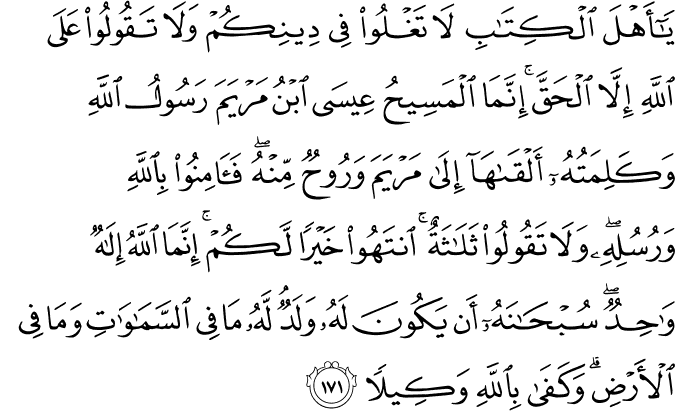
Sahih International
"O
People of the Scripture, do not commit excess in your
religion or say about Allah except the truth. The Messiah,
Jesus, the son of Mary, was but a messenger of Allah and His
word which He directed to Mary and a soul [created at a
command] from Him. So believe in Allah and His messengers. And
do not say, "Three"; desist - it is better for you. Indeed,
Allah is but one God. Exalted is He above having a son. To
Him belongs whatever is in the heavens and whatever is on the
earth. And sufficient is Allah as Disposer of affairs."Abridged Ibn Katheer:
Prohibiting the People of the Book From Going to Extremes in Religion
Allah forbids the People of the Scriptures from going to extremes in
religion, which is a common trait of theirs, especially among the
Christians. The Christians exaggerated over `Isa until they elevated him
above the grade that Allah gave him. They elevated him from the rank of
prophethood to being a god, whom they worshipped just as they
worshipped Allah. They exaggerated even more in the case of those who
they claim were his followers, claiming that they were inspired, thus
following every word they uttered whether true or false, be it guidance
or misguidance, truth or lies. This is why Allah said,
Imam Ahmad recorded that Ibn `Abbas said that `Umar said that the Messenger of Allah said,
This is the wording of Al-Bukhari.
Imam Ahmad recorded that Anas bin Malik said that a man once said, "O Muhammad! You are our master and the son of our master, our most righteous person and the son of our most righteous person...'' The Messenger of Allah said,
Allah's statement,
This is why `Isa was a word and a Ruh (spirit) created by Allah, as he had no father to conceive him. Rather, he came to existence through the word that Allah uttered, `Be,' and he was, through the life that Allah sent with Jibril. Allah said,
And Allah said,
`Abdur-Razzaq narrated that Ma`mar said that Qatadah said that the Ayah,
Therefore, `Ruh from Allah', in the Ayah and the Hadith is similar to Allah's statement,
﴿اتَّخَذُواْ أَحْبَـرَهُمْ وَرُهْبَـنَهُمْ أَرْبَاباً مِّن دُونِ اللَّهِ﴾
(They took their rabbis and their monks to be their lords besides
Allah.) Imam Ahmad recorded that Ibn `Abbas said that `Umar said that the Messenger of Allah said,
«لَا تُطْرُونِي كَمَا أَطْرَتِ النَّصَارَىِ عِيسَى ابْنَ مَرْيَمَ. فَإِنَّمَا أَنَا عَبْدٌفَقُولُوا: عَبْدُاللهِ وَرَسُولُه»
(Do not unduly praise me like the Christians exaggerated over `Isa,
son of Maryam. Verily, I am only a servant, so say, `Allah's servant and
His Messenger.')This is the wording of Al-Bukhari.
Imam Ahmad recorded that Anas bin Malik said that a man once said, "O Muhammad! You are our master and the son of our master, our most righteous person and the son of our most righteous person...'' The Messenger of Allah said,
«يَا
أَيُّهَا النَّاسُ عَلَيْكُمْ بِقَوْلِكُمْ، وَلَا يَسْتَهْوِيَنَّكُمُ
الشَّيْطَانُ،أَنَا مُحَمَّدُ بْنُ عَبْدِاللهِ، عَبْدُاللهِ وَرَسُولُهُ،
وَاللهِ مَا أُحِبُّ أَنْ تَرْفَعُونِي فَوْقَ مَنْزِلَتِي الَّتِي
أَنْزَلَنِي اللهُ عَزَّ وَجَل»
(O people! Say what you have to say, but do not allow Shaytan to
trick you. I am Muhammad bin `Abdullah, Allah's servant and Messenger.
By Allah! I do not like that you elevate me above the rank that Allah
has granted me.)Allah's statement,
﴿وَلاَ تَقُولُواْ عَلَى اللَّهِ إِلاَّ الْحَقَّ﴾
(nor say of Allah except the truth.) means, do not lie and claim that
Allah has a wife or a son, Allah is far holier than what they attribute
to Him. Allah is glorified, praised, and honored in His might, grandure
and greatness, and there is no deity worthy of worship nor Lord but
Him. Allah said;
﴿إِنَّمَا الْمَسِيحُ عِيسَى ابْنُ مَرْيَمَ رَسُولُ اللَّهِ وَكَلِمَتُهُ أَلْقَـهَا إِلَى مَرْيَمَ وَرُوحٌ مِّنْهُ﴾
(Al-Masih `Isa, son of Maryam, was (no more than) a Messenger of
Allah and His Word, which He bestowed on Maryam and a spirit from
﴿created by﴾ Him;) `Isa is only one of Allah's servants and one of His
creatures. Allah said to him, `Be', and he was, and He sent him as a
Messenger. `Isa was a word from Allah that He bestowed on Maryam,
meaning He created him with the word `Be' that He sent with Jibril to
Maryam. Jibril blew the life of `Isa into Maryam by Allah's leave, and
`Isa came to existence as a result. This incident was in place of the
normal conception between man and woman that results in children.This is why `Isa was a word and a Ruh (spirit) created by Allah, as he had no father to conceive him. Rather, he came to existence through the word that Allah uttered, `Be,' and he was, through the life that Allah sent with Jibril. Allah said,
﴿مَّا
الْمَسِيحُ ابْنُ مَرْيَمَ إِلاَّ رَسُولٌ قَدْ خَلَتْ مِن قَبْلِهِ
الرُّسُلُ وَأُمُّهُ صِدِّيقَةٌ كَانَا يَأْكُلاَنِ الطَّعَامَ﴾
(Al-Masih ﴿`Isa﴾, son of Maryam, was no more than a Messenger; many
were the Messengers that passed away before him. His mother ﴿Maryam﴾ was
a Siddiqah. They both ate food.)And Allah said,
﴿إِنَّ مَثَلَ عِيسَى عِندَ اللَّهِ كَمَثَلِ ءَادَمَ خَلَقَهُ مِن تُرَابٍ ثُمَّ قَالَ لَهُ كُن فَيَكُونُ ﴾
(Verily, the likeness of `Isa before Allah is the likeness of Adam.
He created him from dust, then (He) said to him: "Be! ـ and he was.)
﴿وَالَّتِى أَحْصَنَتْ فَرْجَهَا فَنَفَخْنَا فِيهَا مِن رُّوحِنَا وَجَعَلْنَـهَا وَابْنَهَآ ءَايَةً لِّلْعَـلَمِينَ ﴾
(And she who guarded her chastity, We breathed into her (garment) and
We made her and her son ﴿`Isa﴾ a sign for all that exits.) (21:91)
﴿وَمَرْيَمَ ابْنَةَ عِمْرَانَ الَّتِى أَحْصَنَتْ فَرْجَهَا﴾
(And Maryam, the daughter of `Imran who guarded her chastity,) and Allah said concerning the Messiah,
﴿إِنْ هُوَ إِلاَّ عَبْدٌ أَنْعَمْنَا عَلَيْهِ﴾
(He ﴿`Isa﴾ was not more than a servant. We granted Our favor to him.)`Abdur-Razzaq narrated that Ma`mar said that Qatadah said that the Ayah,
﴿وَكَلِمَتُهُ أَلْقَـهَا إِلَى مَرْيَمَ وَرُوحٌ مِّنْهُ﴾
(And His Word, which He bestowed on Maryam and a spirit from ﴿created by﴾ Him;) means, He said,
﴿كُنَّ﴾
(Be) and he was. Ibn Abi Hatim recorded that Ahmad bin Sinan
Al-Wasiti said that he heard Shadh bin Yahya saying about Allah's
statement,
﴿وَكَلِمَتُهُ أَلْقَـهَا إِلَى مَرْيَمَ وَرُوحٌ مِّنْهُ﴾
(and His Word, which He bestowed on Maryam and a spirit from ﴿created
by﴾ Him;) "`Isa was not the word. Rather, `Isa came to existence
because of the word.'' Al-Bukhari recorded that `Ubadah bin As-Samit
said that the Prophet said,
«مَنْ
شَهِدَ أَنْ لَا إِلهَ إِلَّا اللهُ، وَحْدَهُ لَا شَرِيكَ لَهُ، وَأَنَّ
مُحَمَّدًا عَبْدُهُ وَرَسُولُهُ، وَأَنَّ عِيسَى عَبْدُاللهِ وَرَسُولُهُ
وَكَلِمَتُهُ أَلْقَاهَا إِلى مَرْيَمَ وَرُوحٌ مِنْهُ، وَأَنَّ الْجَنَّةَ
حَقٌّ، وَالنَّارَ حَقٌّ، أَدْخَلَهُ اللهُ الْجَنَّةَ عَلَى مَا كَانَ
مِنَ الْعَمَل»
(If anyone testifies that none has the right to be worshipped but
Allah Alone Who has no partners, and that Muhammad is His servant and
Messenger, and that `Isa is Allah's servant and Messenger and His Word
which He bestowed on Maryam and a spirit created by Him, and that
Paradise is true and Hell is true, then Allah will admit him into
Paradise with the deeds which he performed.) In another narration, the
Prophet said,
«مِنْ أَبْوَابِ الْجَنَّةِ الثَّمَانِيَّةِ يَدْخُلُ مِنْ أَيِّهَا شَاء»
(...through any of the eight doors of Paradise he wishes.) Muslim
also recorded it. Therefore, `Ruh from Allah', in the Ayah and the Hadith is similar to Allah's statement,
﴿وَسَخَّرَ لَكُمْ مَّا فِى السَّمَـوَتِ وَمَا فِى الاٌّرْضِ جَمِيعاً مِّنْهُ﴾
(And has subjected to you all that is in the heavens and all that is
in the earth; it is all from Him.) meaning, from His creation. `from
Him' does not mean that it is a part of Him, as the Christians claim,
may Allah's continued curses be upon them. Saying that something is from
Allah, such as the spirit of Allah, the she-camel of Allah or the House
of Allah, is meant to honor such items. Allah said,
﴿هَـذِهِ نَاقَةُ اللَّهِ﴾
(This is the she-camel of Allah...) and,
﴿وَطَهِّرْ بَيْتِىَ لِلطَّآئِفِينَ﴾
(and sanctify My House for those who circumambulate it.) An authentic Hadith states,
«فَأَدْخُلُ عَلَى رَبِّي فِي دَارِه»
(I will enter on my Lord in His Home) All these examples are meant to
honor such items when they are attributed to Allah in this manner.
Allah said,
﴿فَـَامِنُواْ بِاللَّهِ وَرَسُولِهِ﴾
(so believe in Allah and His Messengers.) believe that Allah is One
and Alone and that He does not have a son or wife. Know and be certain
that `Isa is the servant and Messenger of Allah. Allah said after that,
﴿وَلاَ تَقُولُواْ ثَلَـثَةٌ﴾
(Say not: "Three!") do not elevate `Isa and his mother to be gods
with Allah. Allah is far holier than what they attribute to Him. In
Surat Al-Ma'idah (chapter 5), Allah said,
﴿لَّقَدْ كَفَرَ الَّذِينَ قَالُواْ إِنَّ اللَّهَ ثَـلِثُ ثَلَـثَةٍ وَمَا مِنْ إِلَـهٍ إِلاَّ إِلَـهٌ وَحِدٌ﴾
(Surely, disbelievers are those who said: "Allah is the third of the
three.'' But there is none who has the right to be worshipped but One
God.) Allah said by the end of the same Surah,
﴿وَإِذْ قَالَ اللَّهُ يعِيسَى ابْنَ مَرْيَمَ أَءَنتَ قُلتَ لِلنَّاسِ اتَّخِذُونِى﴾
(And (remember) when Allah will say (on the Day of Resurrection): "O
`Isa, son of Maryam! Did you say unto men: `Worship me''') and in its
beginning,
﴿لَّقَدْ كَفَرَ الَّذِينَ قَآلُواْ إِنَّ اللَّهَ هُوَ الْمَسِيحُ ابْنُ مَرْيَمَ﴾
(Surely, in disbelief are they who say that Allah is the Messiah, son
of Maryam.) The Christians, may Allah curse them, have no limit to
their disbelief because of their ignorance, so their deviant statements
and their misguidance grows. Some of them believe that `Isa is Allah,
some believe that he is one in a trinity and some believe that he is the
son of Allah. Their beliefs and creeds are numerous and contradict each
other, prompting some people to say that if ten Christians meet, they
would end up with eleven sects!
Sa`id bin Batriq, the Patriarch of Alexandria and a famous Christian
scholar, mentioned in the year four hundred after the Hijrah, that a
Christian Council convened during the reign of Constantine, who built
the city that bears his name. In this Council, the Christians came up
with what they called the Great Trust, which in reality is the Great
Treachery. There were more than two thousand patriarchs in this Council,
and they were in such disarray that they divided into many sects, where
some sects had twenty, fifty or a hundred members, etc.! When the king
saw that there were more than three hundred Patriarchs who had the same
idea, he agreed with them and adopted their creed. Constantine who was a
deviant philosopher -- gave his support to this sect for which, as an
honor, churches were built and doctrines were taught to young children,
who were baptized on this creed, and books were written about it.
Meanwhile, the king oppressed all other sects. Another Council produced
the sect known as the Jacobites, while the Nestorians were formed in a
third Council. These three sects agreed that `Isa was divine, but
disputed regarding the manner in which `Isa's divinity was related to
his humanity; were they in unity or did Allah incarnate in `Isa! All
three of these sects accuse each other of heresy and, we believe that
all three of them are disbelievers. Allah said,
﴿انتَهُواْ خَيْراً لَّكُمْ﴾
(Cease! (it is) better for you.) meaning, it will be better for you,
﴿إِنَّمَا اللَّهُ إِلَـهٌ وَحِدٌ سُبْحَـنَهُ أَن يَكُونَ لَهُ وَلَدٌ﴾
(For Allah is (the only) One God, hallowed be He above having a son.) and He is holier than such claim,
﴿وَللَّهِ مَا فِى السَّمَـوَتِ وَمَا فِى الاٌّرْضِ وَكَفَى بِاللَّهِ وَكِيلاً ﴾
(To Him belongs all that is in the heavens and all that is in the
earth. And Allah is All-Sufficient as a Disposer of affairs,) for all
are creatures, property and servants under His control and disposal, and
He is the Disposer of the affairs. Therefore, how can He have a wife or
a son among them,
﴿بَدِيعُ السَّمَـوَتِ وَالاٌّرْضِ أَنَّى يَكُونُ لَهُ وَلَدٌ﴾
(He is the originator of the heavens and the earth. How can He have children.)
http://www.islamicstudies.info/ibnkathir/ibnkathir.php?sid=4&tid=13003
Commentary
The word:  : Kalimatuh used
in this verse tells us that Sayyidna 'Isa (A.S) is the 'word' of
Allah. Commentators have given different meanings of this expression:
: Kalimatuh used
in this verse tells us that Sayyidna 'Isa (A.S) is the 'word' of
Allah. Commentators have given different meanings of this expression:
1. Imam al-Ghazzali has said that
two factors operate in the birth of a child: One is the sperm, the
other is the saying of the word  or
'be' by Almighty Allah after which the child comes to exist. Since the
first factor is out of question in the case of Sayyidna 'Isa (A.S),
therefore, it was by attribution to the second factor that he was called
or
'be' by Almighty Allah after which the child comes to exist. Since the
first factor is out of question in the case of Sayyidna 'Isa (A.S),
therefore, it was by attribution to the second factor that he was called  (the word of Allah). It means that he came into existence solely through the word: (be) without the mediacy of material means. In this case, the statement which follows immediately, that is,
  would mean that Almighty Allah delivered this word to Maryam (A.S) as
a result of which the birth of Sayyidna 'Isa (A.S) came to be.
would mean that Almighty Allah delivered this word to Maryam (A.S) as
a result of which the birth of Sayyidna 'Isa (A.S) came to be.
2. Some have said that the expression: (the word of Allah) has been used in the sense of:  (the glad tiding of Allah) and it refers to Sayyidna 'Isa (A.S). It
will be recalled that the glad tiding of the coming of Sayyidna 'Isa
(A.S) given to Maryam (A.S) by Almighty Allah through the angels
carries the expression: Kalimah or word:
(the glad tiding of Allah) and it refers to Sayyidna 'Isa (A.S). It
will be recalled that the glad tiding of the coming of Sayyidna 'Isa
(A.S) given to Maryam (A.S) by Almighty Allah through the angels
carries the expression: Kalimah or word:  (When the angels said, "O Maryam, Allah gives you the good news of a word ... 3:45).
3. Some have said that kalimah (word) has been used here in the sense of 'ayah or sign, as it has appeared elsewhere in the same sense:  'She (Maryam) testified to the word of her Lord as true.' (66:12)
Let us now consider the statement:  (... and a spirit from Him.) in this verse. Worth attention here are
two aspects of our probe. Firstly, why has Sayyidna 'Isa (A.S) been
referred to as ruh or spirit? Secondly, since by saying 'from
Him' the spirit has been attributed to Almighty Allah what, then, would
be the sense of such an attribution?
(... and a spirit from Him.) in this verse. Worth attention here are
two aspects of our probe. Firstly, why has Sayyidna 'Isa (A.S) been
referred to as ruh or spirit? Secondly, since by saying 'from
Him' the spirit has been attributed to Almighty Allah what, then, would
be the sense of such an attribution?
In this connection, several exegetical stances of commentators have been reported. Their gist is being given below:
1. Some of them explain it on the basis of lexical usage. They say that, according to the rule of 'urf or recognized customary practice, the word 'ruh' or
'spirit' is used in the sense of 'essence' to enhance the effect of
pristine purity in something. Since the birth of Sayyidna Isa (A.S)
was totally unrelated to the mediation of any father and he was the
outcome of nothing but the will of Allah, in His supreme majesty, and a
result of the word: (Kun:
be), therefore, he Was blessed with the most perfect degree of purity.
This is the reason why he was called 'a spirit' or 'essence' as
admitted by recognized practice. As for the attribution to Allah, it is
there to hold him in esteem. This is like attributing Masajid (mosques) to Allah in order to enhance the respect in which they are held. Hence, the expression: Masajidullah or the Mosques of Allah. Or, the Holy Ka'bah, by attributing it to Allah, is called: Baytullah or
the House of Allah. Or, by attributing someone religiously observing
and worshipfully obedient to Allah, he is called: 'Abd Allah' or the
servant or slave of Allah. Thus, it is in accord with this formulation
that the Holy Prophet  has been referred to in Surah Bani Isra'il in the wordings:
  (carried His servant) (17:1) where the attribution to Allah reflects honour given to him.
2. Some commentators have said that
the purpose behind the coming of Sayyidna 'Isa (A.S) was that he should
infuse spiritual life into the dead hearts of people and make them
alive once again (familiar as born-again Christians in the West). Since
he was the cause of spiritual life very much like the spirit is the
cause of physical life, therefore, it was in this light that he was
called a spirit. In fact, this word has been used for the Holy Qur'an
as well:  (and thus We have revealed to you a spirit of Our Command - 42:52)
because the Holy Qur'an too blesses people with spiritual life.
(and thus We have revealed to you a spirit of Our Command - 42:52)
because the Holy Qur'an too blesses people with spiritual life.
3. Some others have said that ruh (spirit) is also used in the sense of secret. Since Sayyidna 'Isa (A.S) was, because of his unusual birth, a sign and secret of Allah, therefore, he was called: Ruhullah (the spirit of Allah).
4. Some say that the adjunct is understood here since the statement was to be read as:  (the possessor of a spirit from Him). However, since all rational
beings are equal as the possessors of a spirit, the distinction of
Sayyidna Isa (A.S) was made manifest when Almighty Allah turned his attribution towards Himself.
(the possessor of a spirit from Him). However, since all rational
beings are equal as the possessors of a spirit, the distinction of
Sayyidna Isa (A.S) was made manifest when Almighty Allah turned his attribution towards Himself.
5. According to yet another exegetical view, the word: Ruh has been used in the sense of nafkh or
the blowing of breath. Sayyidna Jibra'il (A.S) had, as commanded by
Allah, blown his breath on the collar of Sayyidah Maryam (A.S) and that
became the conception. Since only a blow of breath had caused the
birth of Savyidna 'Isa (A.S) as a miracle, therefore, he was called: Ruhullah or the spirit of Allah. Another verse of the Holy Qur'an:  (then, We blew Our spirit in her - 21:91) points out in this direction.
In addition to these, several other probabilities have also been suggested. However, none of these come to mean that Sayyidna 'Isa (A.S) is a part of Allah or a divine person on the basis of which it could be suggested that this very spirit we are talking about has manifested itself in the human form, of Sayyidna 'Isa (A.S).
A Telling Repartee
'Allamah Al-Alusi, the author of the famous Tafsir Ruh
al-Ma'ani has reported an episode from the court of Caliph Harun
al-Rashid where a Christian physician entered into a debate against the
scholar 'All ibn al-Husayn al-Waqidi challenging him that his Book
(the Qur'an) has a particular word which indicates that Sayyidna 'Isa
(A.S) is a part of Allah. And as a proof, he read out the verse (171)
which carries the words:  (a spirit from Him). 'Allamah al-Waqidi came up with a rejoinder and recited another verse (45:13) of the Qur'an:
  (The meaning of the verse is that everything that there is in the heavens and the earth is from the same Allah where the word - minhu: from Him - serves to attribute everything to Allah) and said:
  (ruhim-minhu:
a spirit from Him) means, as you think, that Sayyidna 'Isa (A.S) is a
part of Allah, then, the verse I have just recited would mean that
every thing in the heavens and the earth is also a part of Allah?'
Thus, silenced, the Christian physician chose to become a Muslim.
(ruhim-minhu:
a spirit from Him) means, as you think, that Sayyidna 'Isa (A.S) is a
part of Allah, then, the verse I have just recited would mean that
every thing in the heavens and the earth is also a part of Allah?'
Thus, silenced, the Christian physician chose to become a Muslim.
The Qur'an and the Doctrine of Trinity
Reflected in the statement of the Qur'an:  (And do not say "Three") is the state of the major sects among
Christians in which they were divided at the time of the revelation of
the.Qur'an. The doctrine of Trinity they adhered to was base on three
separate principles. One sect maintained that Masih is God and it is
God Himself who has appeared in the world in the form of Masih. The
second sect believed that Masih is the son of God while the third sect
claimed unity in trinity - the father, the son and Mary. Even this
group was split in two. The second group said that the Holy Spirit (Ruhul-Quds)
and not Sayyidah Maryam (Mary) was the third person (hypostasis).
So, these people acknowledged Sayyidna Masih (A.S) as the third of the
three. Therefore, all the three sects have been addressed, separately
and jointly in the Holy Qur'an whereby the Christians have been clearly
told that there is just one truth and that truth is that Masih (A.S)
is a human being born to Maryam (A.S), and a true Messenger of God.
Whatever is said beyond that is all false and ineffectual - whether it
be loaded with the excess of under-estimation, as believed by the Jews,
viz., God forbid, he was an imposter and fabricator: or, be a case of
the excess of over-estimation as believed by the Christians, viz., God
forbid, he is God or the son of God or the third of the three.
(And do not say "Three") is the state of the major sects among
Christians in which they were divided at the time of the revelation of
the.Qur'an. The doctrine of Trinity they adhered to was base on three
separate principles. One sect maintained that Masih is God and it is
God Himself who has appeared in the world in the form of Masih. The
second sect believed that Masih is the son of God while the third sect
claimed unity in trinity - the father, the son and Mary. Even this
group was split in two. The second group said that the Holy Spirit (Ruhul-Quds)
and not Sayyidah Maryam (Mary) was the third person (hypostasis).
So, these people acknowledged Sayyidna Masih (A.S) as the third of the
three. Therefore, all the three sects have been addressed, separately
and jointly in the Holy Qur'an whereby the Christians have been clearly
told that there is just one truth and that truth is that Masih (A.S)
is a human being born to Maryam (A.S), and a true Messenger of God.
Whatever is said beyond that is all false and ineffectual - whether it
be loaded with the excess of under-estimation, as believed by the Jews,
viz., God forbid, he was an imposter and fabricator: or, be a case of
the excess of over-estimation as believed by the Christians, viz., God
forbid, he is God or the son of God or the third of the three.
In many of its verses, the Holy Qur'an has, on the one hand, pointed out to the strayings of the Christians and Jews while, on the other, it has focused brightly on the exalted station of Sayyidna 'Isa (A.S) in the sight of Almighty Allah so that the true path of moderation could emerge clearly from out of the mazes of excess and deficiency.
Those interested in detailed information
about various aspects of Christian beliefs vis-a-vis the veracity of
Islam may wish to study the world-famous book, Izharul-Haqq by Maulana
Rahmatullah Kiranawi. This original work in Arabic has been
translated and published by Darul-Uloom, Karachi, Pakistan in three
volumes with detailed annotations. [An
English translation of this work has been recently completed by Maulana
Muhammd Wali Raazi, son of Hadrat Mufti Muhammad Shafi  and is presently under the process of publication under the auspices of the translator himself.]
Towards the end of the verse, it was declared:  (To
him belongs what is in the heavens and what is in the earth. And Allah
is enough to trust in.). The drive of the meaning is: When everything
has been created by Him, when everything falls under the domain of His
mastery and when everyone is a servant ofAllah, who and how could
anyone become His partner or associate or son? The fact is that
Almighty Allah is the dispenser of all our needs and the sole caretaker
of everyone's wants - He is universally and perennially sufficient, all
by Himself. He needs nobody. How, then, could He need to have a
partner or son?
(To
him belongs what is in the heavens and what is in the earth. And Allah
is enough to trust in.). The drive of the meaning is: When everything
has been created by Him, when everything falls under the domain of His
mastery and when everyone is a servant ofAllah, who and how could
anyone become His partner or associate or son? The fact is that
Almighty Allah is the dispenser of all our needs and the sole caretaker
of everyone's wants - He is universally and perennially sufficient, all
by Himself. He needs nobody. How, then, could He need to have a
partner or son?
To sum up, we can say that no created being has the ability or qualification to become His partner, nor does His most sacred Being have the room or need for it. This much is enough to tell us that suggesting a partner to God or ascribing a son to Him can be accomplished by none but the one who is deprived of faith and reason both.
Excess in Faith
Let us now go back to the opening statement of the verse:  .
In this verse, the People of the Book have been asked not to indulge
in excess in matters relating to their Faith. Lexically, the Qur'anic
word:
.
In this verse, the People of the Book have been asked not to indulge
in excess in matters relating to their Faith. Lexically, the Qur'anic
word:  : al-Ghuluww means to cross the limits or transgress. In Ahkam al-Qur'an, Imam al-Jassas says:

Excess in Faith is crossing the limit set therein.
The People of the Book, that is, the Jews and the Christians were both made addressees of this injunction because excess in Faith is the common factor between them. Both groups have fallen victims to nothing but excess in matters of Faith. The Christians committed excess in believing and honouring Sayyidna 'Isa (A.S) when they went on to the extreme of taking him to be God or son of God or the third God. As for Jews, they committed excess in disbelieving and rejecting him - not simply that they did not accept him even as a prophet, they were audacious enough to, God forbid, impute a false accusation to his revered mother, Sayyidah Maryam (A.S) and to cast a slur against her parentage.
Since the disasterous deviation of
Jews and Christians in matters of Faith was a common scene of the time,
the Holy Prophet especially instructed his community to be very careful about it. According to a report from Sayyidna 'Umar  appearing in the Musnad of Ahmad, the Holy Prophet said:

Do not exaggerate in my praise as was done by Christians in the case of 'Isa son of Maryam (A.S). Beware, I am only a servant. So, call me a servant of Allah and His messenger. (This narration has also been reported by al-Bukhari and Ibn al-Madini rating it as sound and authentically reported)
In brief, the sense of what he said is: I am one
with everyone in being a servant of Allah and a human being. The
highest rank I have is that I am a Messenger of Allah. Raising it
higher to the limit that you go about taking me as partner in the
attributes of Almighty Allah is excess and I do not want you to fall
into this excess like the Christians. This excess in Faith practiced by
the Jews and Christians did not remain limited to prophets only. Once
used to it, they extended this attitude of theirs to the apostles,
followers and deputies of the prophets. They had already assigned
Godhood to their prophet, now they invested the followers of the
prophet with immunity from sin. While doing so, they did not even take
the trouble of investigating and making sure if such followers were
genuine followers of the prophet and who correctly and firmly adhered
to his teachings, or they were no more than hereditary religious
scholars and guides. This resulted in the emergence of a leadership
which was astray in itself and could do nothing but keep adding to the
strayings of others. So, they ruined their Faith by practicing it
erroneously from within. The Holy Qur'an has described this very
condition of these people in the verse:  (that is, these people took their religious leaders as objects of
worship, other than Allah). It means that they had already been
excessive in making their prophet a God, then, they started worshipping
later-day religious leaders in the name of following the prophet!
(that is, these people took their religious leaders as objects of
worship, other than Allah). It means that they had already been
excessive in making their prophet a God, then, they started worshipping
later-day religious leaders in the name of following the prophet!
The lesson to be learnt is that excess in Faith is a dangerous attitude which has destroyed the Faiths of earlier religious communities all in the fair name of Faith. So serious were the implications that our noble master devised perfect defences to keep his community safe against this terrible epidemic.
It appears in Hadith that the Holy Prophet asked Sayyidna'Abdullah ibn 'Abbas on the occasion of Hajj that he should go and collect pebbles which he could use to throw at the Jamarat. He returned with average-sized pebbles and presented them to the Holy Prophet who liked them very much and said twice:  (like these, like these) which means that one should do his or her ramy at Jamarat using average-sized pebbles litfe these. Then, he said:

It is your duty to avoid excess in Faith for communities before you were destroyed because of being excessive in their Faith.
The Ideal Solution
The Shari'ah of Islam has wisely shielded Muslims from falling into the trap of excess. The middle course in between the two extremes it has suggested is: Learn the Book of Allah (Kitabullah) from the Men of Allah (Rijalullah) and recognize the Men of Allah from the Book of Allah. In other words, one should first recognize those who are engaged in learning and communicating the true knowledge of the Qur'an and Sunnah through the all too well-known teachings of these twin sources of Islamic Faith. Once this is settled, no intricate problem relating to Qur'an and Sunnah will ever bother you - if you give precedence to their explanation above your own opinion, and follow them.
Subscribe to:
Posts (Atom)